

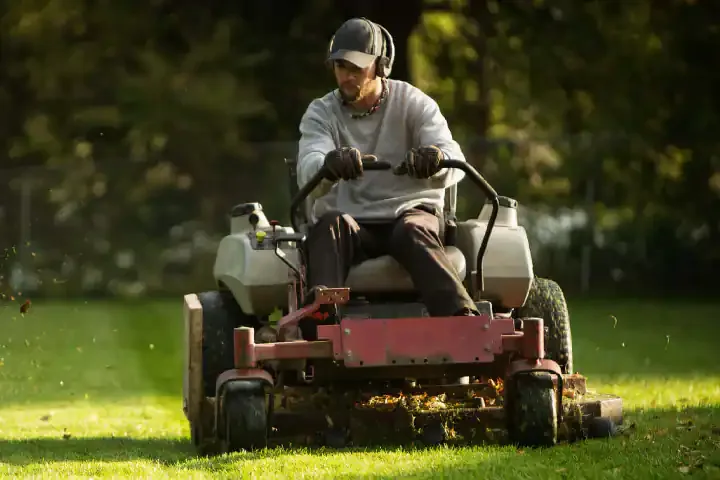
A mower used in a landscaping business is typically insured on a contractors equipment policy, often called inland marine, and not on a personal policy, which generally excludes business use. That policy can respond to theft, damage, and some transit losses, subject to its causes of loss, theft sublimit, and conditions.
Most lawn care businesses begin with a mower. Often it is the same machine that was bought for the house, which is why the first insurance question tends to be about a personal arrangement. This page covers how a business mower is usually insured, what theft and damage claims depend on, and how trailers and personal use fit in. It is deliberately short on the details that existing guides already cover, and it links to them.
The short answer: business use moves the mower to a business policy
Personal policies are built for private use and typically exclude or limit property used in a business. A mower that earns money belongs on a business policy, and the line built for machinery that moves from site to site is contractors equipment. It can respond to theft, fire, vandalism, collision, and other named causes of loss, subject to the form.
That is a general description, not a promise about any policy. What your own policy covers depends on its schedule, its causes of loss, its sublimits, and its exclusions. The guide to whether general liability covers tools and equipment explains why liability does not do this job, and the post on inland marine versus commercial property explains why a property policy on the shop does not follow a mower out the gate.
Theft: the loss that actually happens
Mowers are stolen, from trailers, from truck beds, from open lots, and from garages. A policy’s response to that loss depends on the cause of loss, any theft sublimit, and conditions about how the machine was secured. Unattended and unlocked is the most common sticking point, and a mower left on a trailer overnight can be treated differently from one locked in a building.
The existing guide on a mower stolen off a trailer goes through the scheduled-versus-blanket question and the theft sublimit in detail, so this page does not repeat it. The prevention side is covered in protecting a landscaping business from equipment theft, and the practical habits are ordinary: lock it, chain it, store it inside when you can, and keep a record of serial numbers.
Damage: what the policy responds to and what it does not
Damage to a mower from a covered cause, such as fire, collision, or vandalism, is typically within a contractors equipment policy. Damage from wear, mechanical failure, or a part giving out is a different matter. A basic form often excludes breakdown unless equipment breakdown coverage is added, and the existing guide on equipment breakdown explains the difference.
How a loss is paid also matters. Some policies pay a replacement amount and some pay a depreciated value, and a blanket arrangement can behave differently from a scheduled one. Ask which applies, because a mower that is several seasons old can be paid very differently under each. If the mower throws an object and breaks a customer’s window, that is a liability question rather than an equipment one, and the post on a mower that threw a rock and broke a window covers it.
Trailers and trucks: three pieces, not one
A mower on a trailer behind a truck is three insurable pieces, and they do not always sit on the same policy. The truck is a commercial auto question. The trailer is typically a separate item, sometimes picked up by the auto policy and sometimes not. The mower is an equipment question. A loss that involves all three can reveal that no policy responds to part of it.
For the larger machines that share a trailer, see skid steer insurance for landscapers. The existing explanation of trailers and the equipment inside them explains why the auto policy usually does not pay for what is on the trailer, and the page on commercial auto describes how that line works. For operators with several vehicles, the guide to insuring a small fleet of trucks and trailers is the longer treatment.
Personal use versus business use
Many operators use the same mower for a paid route and for their own property. That is not unusual, and it is not by itself a problem, but it should be disclosed. A policy that insures the mower as business equipment may be written on the assumption that it is used for the business, and a loss at the owner’s home can raise a question about which policy applies.
The simplest approach is to tell your producer how each machine is used, and to ask how the policy treats personal use of a business machine and the reverse. Do the same for the personal policy, which may exclude business use of the mower entirely. A written answer from each producer, kept with the policies, is cheap insurance of its own.
Real-World Scenario: A new operator picks up a handful of mowing accounts using the walk-behind mower bought for personal use, a trimmer, and a borrowed trailer. The personal policy has no business equipment coverage, and there is no business policy yet. A thief takes the mower and the trimmer from the trailer one night. The producer explains that the personal policy probably excludes business use, that a business equipment policy would have been the one to ask, and that the trailer belongs to someone else with a different policy. The operator ends up placing a contractors equipment policy afterward, with a question about whether anything bought later is picked up automatically. The detail that mattered was timing: the policy was not there before the loss.
The small equipment that goes with the mower
Mowers draw the attention, but a route also carries trimmers, blowers, edgers, hedge cutters, and hand tools, and together they can cost as much as the mower. A policy may schedule the larger items and treat the small ones under a blanket amount, or it may not mention them at all. Ask how hand-held and small equipment is handled, whether there is a per-item limit, and whether theft of tools from a truck bed is treated the same way as theft of a mower from a trailer. A crew that carries a dozen small tools and one large mower can have a bigger exposure in the small tools than in the machine it thinks about.
Value, age, and what a claim would pay
A mower loses value each season, and how a policy measures that matters when a claim is paid. A replacement basis typically aims to pay what it costs to buy a comparable machine, while an actual cash value basis typically subtracts depreciation. The difference can be large for an older machine, and it is the kind of detail that is invisible on the first page of a quote.
Ask which basis applies, whether any deductible applies per item or per claim, and how an older, heavily used machine would be valued. Then compare the answer with the machine’s role in the business. A mower that is the center of a route is worth more to you than its depreciated value, and the gap between what it would cost to replace and what the policy would pay is the amount you carry yourself.
Adding machines and keeping the schedule current
A business that grows adds mowers, and the policy has to keep up. Ask whether new equipment is picked up automatically for a period, whether it must be reported, and what happens if it is not. A schedule that lists three mowers when the business now owns five leaves two with an uncertain answer, and a claim is the worst time to find out.
For the wider picture of how equipment is typically structured, see the page on lawn care insurance, which describes the coverage as it is built for a maintenance operation.
What to ask a producer
Ask whether the mower is on the schedule or under a blanket amount, and what a theft claim would pay. Ask what sublimit applies away from the yard and what conditions apply to locking and storage. Ask how trailers and trucks are insured and whether they share a policy with the mower. Ask how breakdown is treated, and how personal use of a business mower is handled. Ask whether new machines are picked up automatically.
Compare the answers with the equipment you actually own. When you are ready, you can start a quote and describe the machines, where they are kept, and how they are moved. For who answers your questions and how we place this kind of work, see about us. For general business insurance guidance, the U.S. Small Business Administration is a reasonable reference, and your state’s insurance department, listed by the National Association of Insurance Commissioners, can explain how producers and policies are regulated where you work.