
Insurance by operating model
Lawn Care Business Insurance for Mowing and Fertilizing Crews
Insurance for the recurring lawn maintenance operator — mowing, fertilization, weed and turf-pest control, and aeration on a route — structured around the chemical-application model, where the herbicide, pesticide, and fertilizer drift, misapplication, and runoff exposure leads the risk profile and per-state applicator licensing matters most.
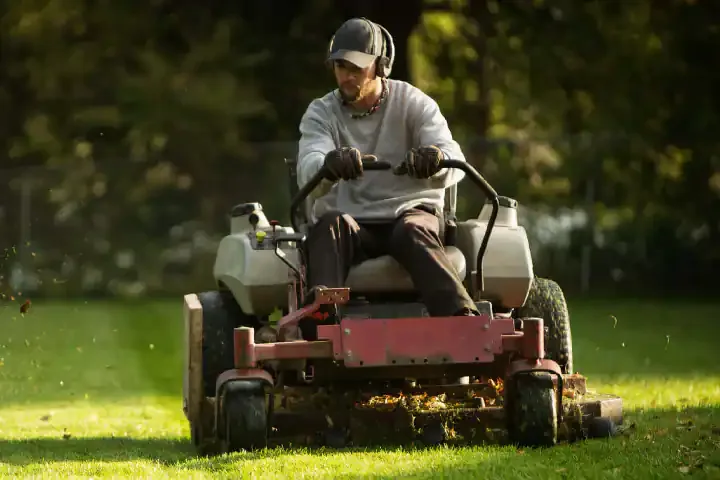

Lawn care insurance covers the three exposures a route runs every working day: a mower deck throwing a rock through a window or at a bystander, herbicide, pesticide or fertilizer that drifts, is misapplied or runs off, and the techs who handle chemicals and equipment in the field. General liability, pollution liability and workers compensation carry them.
Recurring lawn care is its own operating model, not a coverage line — and the way a maintenance crew works is what makes its insurance distinct. A lawn care operation runs a route: techs visit the same accounts on a recurring schedule, mow and trim, put down fertilizer, treat weeds and turf pests, and aerate on a seasonal cycle. The work that lives inside this model is the recurring maintenance work — mowing, fertilization, weed and turf-pest control, and aeration. It is steady, route-driven, and built on repeat visits to the customer properties a crew services over and over. That is a very different risk picture from a one-time design and build project, and it demands a program built around the route and, above all, the chemical the route puts down.
One exposure defines the model and concentrates the risk above all others: chemical application. On the maintenance side the chemical is not incidental to the work — it is the work. When your applicators put down a regulated herbicide, pesticide, or fertilizer, they are dispersing a chemical across an environment that may border a neighbor’s ornamentals, a vegetable bed, a pond, or a storm drain. If that product reaches somewhere it should not — drift onto a neighboring property, a misapplication that burns a customer’s turf, or runoff into a waterway — the loss that follows is a pollution condition, and the standard general liability form carries an absolute pollution exclusion that bars exactly that chemical loss. That is why pollution liability is the signature placement for this model, and why we link it heavily: it is the line that stands between a drift complaint or a burned-lawn claim and a bill general liability will not touch.
Two more exposures round out the route. The first is the thrown object from a mower — a mower deck spinning at speed will pick up a rock, a piece of mulch, or metal and fling it hard enough to break a window, dent a parked car, or injure a bystander, a third-party claim that runs through general liability. The second is the tech in the field — your techs handle chemicals, operate mowers and equipment, lift, work in the heat, and drive the route, a field-injury profile that runs through workers compensation. On top of those, the recurring-route model carries the realities of running a service fleet and the mowers and gear that ride the trailer every day.
This page covers how lawn care insurance is built as a whole for the recurring maintenance model: what the chemical-application model is and the work it covers, the application and route risk profile, the full coverage stack the model needs, the drivers that move cost, and how carriers underwrite a route-based chemical operation. Lawn care does not do design and build — if your operation also runs hardscape, planting, and grading projects, the Landscaping Insurance page is built for that one-time project model, and the Lawn Irrigation Installation Insurance and Landscape Lighting Insurance pages cover those installation models.
Running a recurring lawn care route? Get a quote structured around your accounts, your chemical application, and the techs in the field.
Get a Free QuoteWhat makes lawn care insurance different
Lawn care risk is route-and-application risk, and it lands hardest on two coverage lines in a way a generic contractor form does not anticipate. Pollution liability carries the chemical weight — and it is the defining seam of the trade, because the application of a regulated product that drifts, is misapplied, or runs off is the loss the standard general liability form flatly excludes, and the maintenance model runs that exposure on a route, at scale, every working day. General liability carries the on-site and thrown-object weight, because a mower throwing debris and a tech in a customer’s space on every visit are the everyday third-party exposure of a route. A policy rated to a generic service business treats neither with the emphasis a chemical-application operation needs.
The practical consequence is that two lawn care operations with similar revenue can carry very different exposures depending on how much chemical the route actually puts down. A crew running heavy fertilization and weed-control treatment near sensitive accounts looks nothing like a crew doing mostly mowing with light treatment — and writing both off one form underprices the chemical exposure and strands the pollution risk. We separate the chemical-application scope from any design and build, irrigation, or lighting work in the same book so none is mispriced, and we weight the stack toward the lines the maintenance model leans on.
The work this covers
The recurring maintenance model holds several kinds of work that share one risk profile — a tech on a recurring route, product applied across account after account, and a customer relationship that repeats on a schedule. These are the services that live within this pillar rather than standing on their own:
- Mowing and trimming. The recurring cut-and-trim work that anchors a maintenance route — the everyday service where the thrown-object-from-a-mower exposure sits, performed across many accounts on a schedule.
- Fertilization. The recurring application of fertilizer across customer turf — a nutrient-product application performed at scale on a route, where the runoff and misapplication exposure runs highest.
- Weed and turf-pest control. Herbicide and turf-pest treatment to control weeds and pests in the turf — the chemical-application work at the center of the pollution exposure, where drift, misapplication, and per-state applicator licensing matter most.
- Aeration and turf maintenance. Core aeration, overseeding, and the seasonal turf-health work that runs alongside the treatment route — recurring maintenance that keeps a crew on the same accounts across the season.
Design and build, irrigation install, and landscape lighting install are not part of this model — they carry their own signature exposures and live on the Landscaping Insurance, Lawn Irrigation Installation Insurance, and Landscape Lighting Insurance pages. If your operation runs more than one of these models, each scope is underwritten on its own terms.
State and regulatory considerations
Recurring lawn care sits at the intersection of pesticide regulation, applicator licensing, and worker safety — and the rules vary by state, which is why per-state applicator licensing matters most for this model. The federal floor is the U.S. EPA pesticide program under FIFRA, which governs how pesticides and herbicides are registered, labeled, and used — and the label is the law your applicators apply by. Fertilizer and chemical runoff is its own recognized environmental concern: the EPA treats nitrogen and phosphorus pollution from fertilizer as a water-quality issue (EPA — Nutrient Pollution), and a fertilization route runs that exposure at scale. Chemical and fertilizer applicator licensing is primarily a state Department of Agriculture function carried out under that federal framework, sometimes through a state pesticide board — a state-by-state patchwork. Worker safety on the route, including chemical handling and hazard communication, runs through OSHA standards.
On top of the federal layer, workers compensation rules vary by state — including the four monopolistic states where coverage comes only from the state fund, which matters for a crew that runs a route across state lines. As our state pages come online we link the applicator-licensing, regulatory, and worker-safety specifics for the states we serve. Lawn care activity concentrates in long-season, high-turf-market regions, so Tier-1 markets include states such as Texas, Florida, California, Georgia, and North Carolina, and we write across all 48 licensed states.
Coverage breakdown
Here is the stack a recurring lawn care operation carries, weighted for the chemical-application model. Each line links to its full page — and the two that carry the most weight, pollution liability and general liability, are the signature placements for this model.
- Pollution Liability Insurance — the signature applicator line: herbicide, pesticide, and fertilizer drift onto a neighboring property, misapplication that burns a customer’s turf, overspray, runoff, and the environmental cleanup the standard general liability form flatly excludes. The pollution liability page covers the mechanism in full.
- General Liability Insurance — a signature line: third-party bodily injury and property damage from the route, the rock thrown from a mower deck, the slip on a treated surface, and the on-site exposures of a recurring service crew.
- Workers Compensation Insurance — medical and lost-wage coverage for techs handling chemicals, operating mowers and equipment, lifting, and driving the route, structured for the multi-state reality of a traveling crew.
- Commercial Auto Insurance — the trucks and trailers your techs drive and tow every day, the daily-stop accident exposure, and the gear in transit between accounts.
- Contractors Equipment Insurance — the mowers, zero-turns, spreaders, sprayers, and handheld gear that ride the trailer all day, insured as inland marine at the shop, in transit, and on the account.
- Umbrella Liability Insurance — excess limits above general liability and commercial auto for larger operations and the higher limits HOA, commercial-property, and municipal contracts often require.
What lawn care insurance costs
Premium tracks the route and the chemistry, not a sticker price. The drivers that move it most are your payroll and the technician classifications it covers, how much of your scope is chemical treatment versus mowing-only maintenance, the products and rates your crews apply and how close they work to sensitive accounts and water, the size and value of your mowers and route equipment, the mix of residential and commercial accounts you service, the limit and additional-insured requirements your commercial contracts impose, your applicator-licensing and training discipline, your multi-state footprint, and your claims history — particularly any drift, misapplication, or runoff losses. A crew running heavy chemical treatment near occupied and sensitive accounts looks very different to an underwriter than one doing mostly mowing. We price to that real picture and stand behind any figure we give — verified ranges come from us directly, never a generic guess.
Claims scenarios
These are plausible recurring lawn care claim categories, described qualitatively and with generic carrier language — every claim is handled by the carrier, never named here — and with no fabricated cost or frequency figures.
- Herbicide drift onto a neighboring property. A treatment drifts or overspray reaches an adjacent property’s ornamentals, garden, or water source — the chemical loss most specific to a chemical-application route, where general liability’s pollution exclusion pushes the exposure to pollution liability.
- Misapplication that burns a customer’s turf. The wrong product, the wrong rate, or treatment of the wrong site kills or burns a customer’s turf or beds — a pollution-driven property-damage claim built on a chemical condition.
- Fertilizer or chemical runoff. Product washes or migrates off the turf into a storm drain, ditch, or waterway, triggering an environmental cleanup and a potential regulatory demand the standard general liability form excludes.
- A rock thrown from a mower. A mower deck flings a rock or debris that breaks a window, damages a parked car, or injures a bystander — the everyday third-party general liability exposure of a mowing route.
Underwriting realities
Carriers writing the recurring lawn care class look at the route and the chemistry: payroll and technician classifications, the products and rates your crews apply, how close you work to sensitive and occupied accounts and water, your applicator-licensing and training discipline, your fleet and where the gear is stored, your subcontractor controls, and your loss history. Documented applicator certification, label-compliant application practices, strong subcontract and certificate discipline, and a clean drift and misapplication history open more markets; a serious drift, misapplication, or runoff loss narrows them. Operations that also run design and build, irrigation, or lighting divisions get those portions underwritten separately so the chemical-application route is not subsidizing — or stranding — the rest of the book. We position your operation to the carriers most likely to want a recurring chemical-application risk rather than sending one generic submission everywhere.
Why Landscaping Guard Insurance
We write one trade — commercial landscaping and lawn care operators — and within it we treat recurring lawn care as the route-based, chemical-application operation it is. We weight your stack toward the pollution liability and general liability exposures a maintenance crew actually carries, read the pollution wording against the products and rates your applicators apply rather than assuming it away, write general liability for the thrown-object and on-site exposures of a mowing route, structure workers compensation for a crew that crosses state lines, schedule the mowers and gear that ride the trailer, and set the subcontractor and additional-insured requirements that keep a sub’s drift off your policy. We place coverage with carriers that want the lawn care class. Start with a quote, or send us a commercial account’s insurance requirements and we will tell you what limits and coverage it requires.
Learn more
Recurring lawn care is one of four landscaping operating models, and the coverage stack shifts with the work. The signature exposures for this model live on the pollution liability and general liability pages. If your work is one-time design and build instead, the Landscaping Insurance page leads with the property-damage and equipment exposure that model carries; the Lawn Irrigation Installation Insurance and Landscape Lighting Insurance pages are built for those installation models — and the landscaping insurance services overview explains how the four differ.
Coverage for recurring lawn care operations
- General Liability Insurance
- Commercial Auto Insurance
- Workers Compensation Insurance
- Contractors Equipment Insurance
- Pollution Liability Insurance
- Umbrella Liability Insurance
Landscaping specialties
- Landscaping Insurance
- Lawn Care Insurance
- Lawn Irrigation Installation Insurance
- Landscape Lighting Insurance
Get covered
Primary sources
Frequently asked questions about Lawn Care Insurance
What insurance does a recurring lawn care operation need?
A recurring lawn care operation typically carries pollution liability, general liability, workers compensation, commercial auto, contractors equipment, and an umbrella as its core stack. The weight sits on two lines: pollution liability for the herbicide, pesticide, and fertilizer application that is the core of the work and that general liability flatly excludes, and general liability for the on-site and thrown-object exposures of a mowing and treatment route. We build the stack around the way your crews actually run a route and apply product rather than rating you off a generic contractor policy.
Why does a recurring lawn care operation lead with pollution liability?
Because on the maintenance side the chemical application is not incidental to the work — it is the work. A fertilization and weed-control route puts down regulated herbicide, pesticide, and fertilizer across customer property after customer property on a recurring schedule, and when a treatment drifts onto a neighboring property, is misapplied at the wrong rate or site, or runs off into a storm drain, the resulting claim is a pollution condition — and the standard general liability form carries an absolute pollution exclusion that bars exactly that chemical loss. Pollution liability, sometimes written as applicator coverage, is the separate line that fills that gap, and it is the signature placement for the recurring maintenance model. The pollution liability page covers the mechanism in full.
Does general liability cover herbicide drift onto a neighboring property?
Usually not in the way operators assume. General liability may respond to some immediate third-party damage, but its absolute pollution exclusion bars the chemical-contamination, drift, and runoff portion — which is exactly the part of a drift or misapplication incident that drives the loss. The herbicide, pesticide, and fertilizer your applicators put down fall squarely inside the way that exclusion defines pollutants. That gap is why pollution liability exists and why we place it alongside general liability for a chemical-application route rather than assuming the standard form will answer. We read the wording against the products and rates your crews actually apply.
Does general liability cover a rock thrown from a mower?
Yes — that is core general liability territory. When a mower deck throws a rock, a piece of mulch, or debris and it breaks a window, dents or cracks a parked car, or strikes and injures a bystander, that is third-party property damage or bodily injury your operation caused, and general liability is the line built to respond. It is one of the most common claims a mowing route generates, which is why we write general liability alongside the pollution coverage. The thrown-object exposure runs through general liability; the chemical-application exposure runs through pollution liability — two different lines for two different parts of the same route.
Does following the label and applicator rules mean I do not need pollution liability?
No. Applying a product to its label and holding the right state applicator certification under the federal framework is the standard of care, and it is essential — but it does not remove the exposure. Wind shifts, a sensitive site goes unflagged, a rate is read wrong, a non-target bed or pond is in the spray path. A drift, misapplication, or runoff claim can still arise on a job where your applicator did everything right, and a clean compliance record strengthens your file and your defense without replacing the coverage. Pollution liability is what responds when the claim comes anyway.
Does lawn care insurance also cover design and build work?
Not automatically, and that is by design. Lawn care is the recurring maintenance and chemical-application operating model — mowing, fertilization, weed and turf-pest control, and aeration on a route. Design and build work — hardscape, planting, grading, and installation — is a genuinely different operating model with its own signature exposure: the third-party property damage of heavy equipment on a customer’s site and the high-value equipment fleet. If your operation also runs design and build projects, the landscaping pillar page is built for that model, and we structure that scope deliberately rather than folding it into a maintenance policy.
How does workers comp work for lawn care techs who run a route across state lines?
It is one of the trickier parts of running a route-based operation that crosses borders. When a tech lives in one state and services accounts in another, workers compensation has to account for payroll earned across state lines, extraterritorial and reciprocity rules, and the four monopolistic states where coverage comes only from the state fund. The field injury profile of a lawn care tech — chemical handling, mower and equipment operation, lifting, heat, and driving the route — makes a comp gap especially serious. We structure workers compensation for the multi-state reality of a traveling route rather than a single home base.
Lawn care insurance by state
We write recurring lawn care operations in all 48 licensed states. Pick your state for its applicator-licensing, workers-compensation, and coverage picture.
- Alabama
- Arizona
- Arkansas
- California
- Colorado
- Connecticut
- Delaware
- Florida
- Georgia
- Idaho
- Illinois
- Indiana
- Iowa
- Kansas
- Kentucky
- Louisiana
- Maine
- Maryland
- Massachusetts
- Michigan
- Minnesota
- Mississippi
- Missouri
- Montana
- Nebraska
- Nevada
- New Hampshire
- New Jersey
- New Mexico
- New York
- North Carolina
- North Dakota
- Ohio
- Oklahoma
- Oregon
- Pennsylvania
- Rhode Island
- South Carolina
- South Dakota
- Tennessee
- Texas
- Utah
- Vermont
- Virginia
- Washington
- West Virginia
- Wisconsin
- Wyoming
Insure your route the way your crew runs it
Tell us about your accounts, your chemical application, and the techs in the field, and we will market it to carriers that write the lawn care class.