

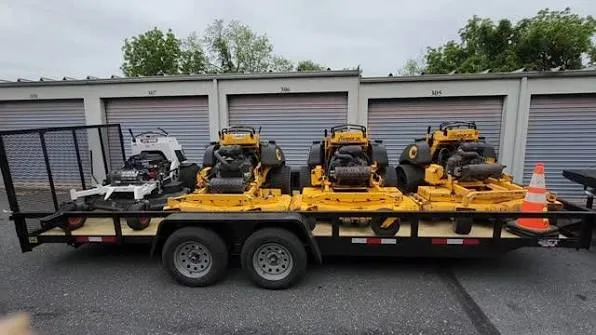
Yes — if you carry contractors equipment, the inland marine line written to follow your owned gear off-premises. A mower stolen off the trailer is the single most common equipment claim a landscaping operation brings, and the policy that responds is not the one most operators reach for first. It is not your commercial auto, and it is not your commercial property. This guide walks exactly which line answers, why the other two do not, and the one check that decides whether the claim actually pays.
That trips operators up, because the loss happened on the trailer — and the trailer feels like an auto thing, or it happened away from the shop, which feels like nothing the property policy reaches. Both instincts send the claim to the wrong policy. Below is the narrow question — a mower gone off the trailer — answered in full, with the broader equipment-coverage mechanics left to the page they belong on.
The short answer: contractors equipment, the line that follows the gear
A mower taken off your trailer is a first-party theft of your own movable equipment, and the form built for exactly that is contractors equipment, written as inland marine. Inland marine is the family of coverage for property that travels or sits away from a fixed premises, so it follows the gear wherever the work takes it — in the yard, on the trailer between accounts, and parked at the job site. When the machine disappears off the trailer, this is the line that responds, subject to the policy terms, the schedule or blanket limit, and any security conditions on the form. The full anatomy of how the line is structured lives on our contractors equipment page — this post stays on the single question operators actually search the night the trailer comes up light: which policy pays for the stolen mower.
Why the auto policy does not pay for the stolen mower
Here is the seam operators trip over most, and it is worth being precise about. Your commercial auto policy covers the truck and the trailer as vehicles — the collision, the liability, the trailer as a titled and registered unit being towed down the road. What it does not cover is the load. The mowers, the zero-turns, the trimmers and blowers riding on that trailer are not part of the vehicle; they are your equipment, and the auto form was never written to insure them. So when a thief unhitches the trailer and drives it off, the auto policy may answer for the trailer itself as a stolen vehicle — but the machines that were on it are a separate question, and the answer is contractors equipment, not auto.
The confusion is understandable, because the trailer and the gear move as one unit all day and a road loss can damage both at once. But the policies split them cleanly: auto for the trailer as a towed vehicle, inland marine for the equipment loaded on it. A single trailer theft can touch two policies at once for exactly this reason — and if you only carry the auto side, the most valuable part of the loss, the machines, has nothing behind it. This is also why the commercial auto page itself draws the line back to the equipment that rides on the trailer rather than trying to cover it on the auto form.
Real-World Scenario: A crew parks the truck and a loaded tandem trailer in a hotel lot overnight on the way to a multi-day install. Before dawn the trailer is gone — hitched and driven off with two zero-turns, a walk-behind, and a rack of handheld gear on it. The operator calls the auto carrier expecting the whole loss to be covered, and learns the auto policy reaches the trailer as a vehicle but not the machines that were on it. The trailer is recovered empty a week later; the equipment is not. The contractors equipment policy is the line that would have answered for the mowers and the gear — the part of the loss that actually hurt.
Why the property policy does not follow the gear
The other instinct is to file it on the commercial property policy, and that fails for a different reason: location. A commercial property policy is tied to a fixed address — the shop or yard you run from — and it is built for the things that stay put there. Once your equipment leaves that address, the property form largely stops following it. A mower stolen from a trailer in a parking lot, or off an open job site, was nowhere near the insured premises when it vanished, so the property policy has no claim to answer.
Some property policies carry a small off-premises extension, but it is usually a modest sublimit meant for incidental property, not a working fleet of machines that spends every hour of the day off-premises. Relying on it to cover a stolen zero-turn is how operators discover the cap is a fraction of what the machine was worth. Inland marine exists precisely to close that gap: it is the form for property that travels, and contractors equipment is the inland marine line for owned, movable business equipment. The whole reason this trade carries it is that the most valuable property a landscaping operation owns does almost nothing at the shop address — it earns its money everywhere else.
The check that decides whether the claim pays: scheduled, blanket, and the theft sublimit
Knowing the right policy is half the answer. The other half is whether the gear is actually set up on that policy to respond, and there are three things to confirm before a theft ever tests it. First, is the machine scheduled — listed individually with its own limit set to replacement value — or is the item type covered under the blanket (unscheduled) limit? High-value machines like a zero-turn or a skid steer are usually scheduled; the pool of small handheld gear is usually blanket. A stolen mower needs to be on one or the other. Second, what is the theft sublimit? A policy can carry a cap on theft specifically, and sometimes a tighter cap on theft from an unattended trailer or vehicle — the exact scenario that drives this loss. Third, what security conditions does the form attach? Some require the trailer locked or the gear secured before they pay a theft claim, and a condition you never read can be the thing a claim is denied on.
That is the reading we do against your actual fleet before you bind. The point of this post is narrow and firm: the stolen mower routes to contractors equipment, not auto or property — and the difference between an assumed coverage and one that actually pays is whether the gear is scheduled or blanketed and whether the theft sublimit and conditions match the way your crews park, load, and travel.
What to do before the lot comes up empty
Treat the off-the-trailer theft as a question of when, not if, because the gear spends its day in the least secure places the work can put it — a curbside trailer, an open job site, a fuel stop, a lot after dark. Carry contractors equipment as the line that follows the gear, confirm your high-value machines are scheduled and your small gear is covered blanket, and have the theft sublimit and security conditions read before a loss tests them. Coordinate it with your commercial auto so the trailer-as-vehicle and the gear-on-the-trailer each sit on the policy built for them, the way the commercial auto and trailer seam plays out for a real fleet. If you run a maintenance route, the lawn care and landscaping models load and unload constantly, which is exactly the exposure this line is written for. When you are ready, start a quote and tell us what machines you run and how they travel, read the full contractors equipment treatment, or see where the equipment line sits in what drives landscaping insurance costs. And if you have ever assumed your general liability would cover your own stolen mower, read whether general liability covers your tools and equipment — it does not, and knowing why is the rest of this picture.