

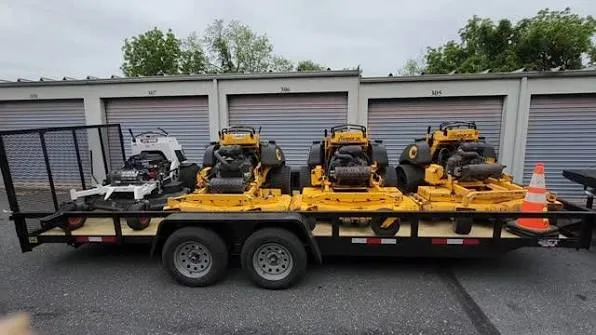
The trailer, generally yes — the equipment loaded on it, no. Your commercial auto policy covers the trailer itself as a vehicle while it is attached to a covered truck and scheduled on the policy, but it does not cover the mowers, skid steers, blowers, and gear riding on that trailer. That load is a first-party loss to your own property, and it runs to a different line. This guide walks the seam exactly: what auto reaches, what it hands off, and the one piece — a detached trailer — that can fall out of the auto policy entirely.
The reason this trips operators is that the whole rig feels like one thing. You hook up, you tow, the truck and the trailer and the gear roll out together, so the assumption is that one policy covers the lot. It does not. The rig splits across two policies by what each piece actually is, and there is a third piece in between — the detached trailer — that you have to confirm rather than assume. Below is that narrow question answered in full, with the deeper coverage mechanics left to the pages they belong on.
The short answer: the trailer is auto, the gear inside is not
Commercial auto is written for the vehicle and its operation. A trailer is a thing you tow, so while it is attached to a covered truck and scheduled on the policy, the trailer reads as a vehicle — the liability while you are towing it and physical damage to the trailer itself are on the auto side. What the auto policy does not reach is the equipment loaded on that trailer. The mowers, skid steers, trimmers, and blowers are your own property, and a first-party loss to your property is insured under contractors equipment, an inland-marine line written to follow the gear wherever it goes. The full mechanics of where auto stops, and how the equipment line picks up the load, live on the commercial auto page — this post stays on the single question operators actually search: does the auto policy cover the trailer and the gear inside it, and the answer is that it covers one and not the other.
The trap: the rig looks like one insured thing
Here is where operators get caught. The truck, the trailer, and the load roll out as a single unit every morning, so it is natural to picture one policy wrapped around the whole rig. That mental model is the problem. Insurance does not see the rig; it sees a vehicle, some cargo, and a question about when the trailer counts as a vehicle at all. The truck is a vehicle. The trailer is a vehicle while it is attached and scheduled. The mowers and gear loaded on it are not vehicles — they are your equipment — so they are insured as property, on a different line, even though they are physically sitting on something the auto policy does cover. The seam runs right down the middle of the rig, between the trailer and what is loaded on it, and a generic policy that rates you like a truck that never tows will not draw that seam for you.
Real-World Scenario: A crew tows a loaded trailer to a maintenance account, and on the way home the rig is hit at an intersection. The truck is damaged, the trailer is bent, and two mowers and a load of trimmers strapped to the trailer are wrecked. The operator files one claim with the auto carrier expecting the whole loss handled — and learns the auto policy answers for the truck and the trailer as vehicles, but not for the mowers and gear that were on the trailer. That equipment is a first-party loss that belongs on contractors equipment. With both policies in force the loss is covered end to end; with only auto, the most valuable part of the rig — the gear — is the part the operator is paying for alone.
The three pieces, and the one that hides
The clean way to think about the rig is as three separate pieces, each placed on the policy meant for it.
The first piece is the attached trailer. While it is hooked to a covered truck and scheduled on the policy, the trailer is treated as a vehicle on the commercial auto side — liability while you tow it and physical damage to the trailer itself. This is the piece operators usually have right.
The second piece is the equipment inside. The mowers, skid steers, blowers, and trimmers riding on the trailer are a first-party loss to your own property, and they run to contractors equipment, the inland-marine line written to follow the gear at the shop, in transit on the trailer, and on the job site. If those mowers are damaged in a wreck or stolen off the trailer at a site, that is the equipment line, not auto. The deeper treatment of how the equipment line responds — including the trailered-gear scenarios — lives on its own page and in the sibling posts on whether a mower stolen off a trailer is covered and how inland marine differs from commercial property for landscaping equipment. This post does not restate them; it points to where the load belongs.
The third piece is the one that hides: the detached trailer. Commercial auto generally treats the trailer as a vehicle while it is attached to a covered truck. Unhook it — leave it sitting in the yard, at a job site, or behind the shop overnight — and depending on how the auto form is written, the trailer can fall outside the policy that covered it while it was rolling. Some programs extend coverage to an unattached trailer; some do not. This is not a piece to assume your way through, because the gap only appears at the moment a detached trailer is stolen or damaged.
The actionable check: schedule both, then confirm the detached trailer
The fix is concrete and you can do it before any claim tests the rig. First, make sure the trailer is scheduled on your commercial auto policy so the attached trailer is covered as a vehicle. Second, make sure the equipment loaded on it is scheduled on contractors equipment so the mowers and gear are covered as first-party property wherever they ride and work. Those two placements cover the rig in motion. Third — and this is the one operators skip — ask your broker in writing how a detached trailer is treated under your auto form, and where the trailer sits if it is taken or damaged while unhooked. Get the answer in writing, not as a verbal assurance, because this is exactly the kind of detail that is clear in a policy form and fuzzy in memory.
When all three are placed and the auto and equipment lines are written to meet, the seam is sealed: the attached trailer is auto, the load is the equipment line, and the detached trailer has a confirmed home rather than a quiet gap. That is the difference between a rig that is covered end to end and one where a single wreck or overnight theft lands on you.
Why operators learn this at a claim
The reason this gap is so common is that nothing about it feels like a gap while the rig is rolling. The trailer is on the auto policy, the auto policy is real, and the load is right there on the trailer the policy covers — so it is easy to believe the whole rig is handled. The seam only shows up when a loss forces the carrier to sort the rig into pieces: the truck and trailer here, the equipment there, the detached trailer maybe nowhere. Operators who map the three pieces in advance are the ones who carry both lines and confirm the detached-trailer question; the rest find the seam in a claim letter. The honest answer is also the useful one — the auto policy covers the trailer, not the gear inside it, and knowing exactly where that line falls is what lets you place every piece of the rig before it is tested.
What to do before the next tow
Treat the rig as three pieces and place each one. Schedule the trailer on your commercial auto policy, schedule the equipment on contractors equipment, and get a written answer on how a detached trailer is handled — then make sure the two lines are written to meet so nothing on the trailer falls between them. For a landscaping operation that tows loaded trailers to job site after job site, the equipment on those trailers is the biggest asset you own, and the seam between the trailer and the load is the one most worth getting right. When you are ready, start a quote and tell us what you tow, read the full commercial auto and contractors equipment treatments to see exactly where each line responds, or step back to what drives landscaping insurance costs to see how the fleet and the equipment schedule fit the program.