

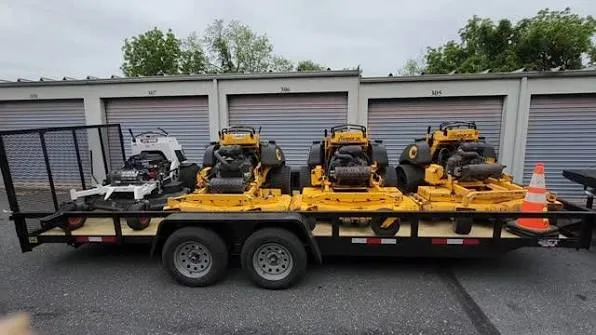
Equipment theft is one of the most common and costly losses a landscaping operation faces. The reason is built into the work: mowers, zero-turns, trailers, and handheld gear are valuable, portable, and spend their days out in the open — on job sites, riding the trailer, parked at the shop overnight. The same portability that makes the equipment useful is exactly what makes it a target, and an operation that lives on its gear cannot afford to treat protecting it as an afterthought. The good news is that theft prevention is not one decision but a stack of layers, each cheap to add, and together they make the operation a harder target and the recovery faster when something does go missing.
No single measure stops a determined thief. A lock can be cut, a tracker can be missed, a marked machine can still be taken. But layered, the measures compound: a thief who has to defeat a lock, then an immobilizer, then a GPS unit, on equipment that is marked and registered and stored in a secured lot, is a thief who moves on to an easier target. This guide walks the layers from the equipment outward — lock it, mark and track it, secure the place it lives, and insure what is left — because that is the order in which the defense actually stacks up.
Layer one: lock and immobilize the gear
The first layer works at the equipment itself, making it physically harder to take. A mower that can be rolled off a trailer in seconds is a different target from one secured with a wheel lock; a trailer that can be hitched and driven away is a different target from one fitted with a coupler lock and a wheel lock so it cannot be towed. Ignition immobilizers and removable keys keep a machine from simply being started and driven off the lot. None of these is foolproof — a lock can be cut and an immobilizer can be defeated with time — but each adds the one thing a thief most wants to avoid: time and noise.
The principle is friction. Most equipment theft is opportunistic, a fast grab from a trailer, a job site, or an unsecured lot, and the measures that defeat it are the ones that turn a thirty-second theft into a several-minute job that draws attention. Wheel locks on the trailers and the higher-value machines, coupler locks on every trailer, and immobilizers or removed keys at the end of the day are cheap, and they move the operation out of the easy-target category. The gear that is locked and immobilized is the gear a thief leaves behind for an easier one nearby.
Layer two: mark, register, and track
The second layer assumes a theft may still happen and is built to recover the equipment afterward. Marking the gear visibly — with the company name, an etched identifier, or a permanent tag — makes it harder to resell and easier to identify, and a marked machine is one a buyer or a recovering officer can connect back to you. Registering serial numbers is the quiet workhorse here: a registry of every machine’s serial number, with photos and purchase records, is what lets a recovered machine be proven yours and what makes a theft claim clean and documented. Without recorded serial numbers, a recovered mower cannot be tied to your operation, and a claim is harder to substantiate.
GPS and telematics add tracking to the highest-value machines. A unit that reports a machine’s location gives recovery a real chance after a theft and can deter one when a thief knows the equipment is tracked. Tracking is most worthwhile on the expensive, attractive machines — the skid steers, the larger mowers, the equipment whose loss would hurt — because the cost of a unit is small against the value of getting the machine back. Like every layer, tracking does not stop the theft on its own; it improves the odds of recovering what was taken, which is exactly what this layer is for.
Layer three: secure the place it lives
The third layer protects the place the equipment sits when no one is using it, which is where a great deal of theft happens — overnight, at the shop, on the lot, or off a trailer left loaded. Securing that place means denying easy access: a fenced and gated lot, lighting that removes the cover of darkness, and a storage approach that does not leave the most valuable gear sitting in the open and reachable from the street. Equipment stored inside a locked building overnight is far harder to take than equipment left on a trailer in an open lot.
The trailer deserves its own attention, because a loaded trailer is a rolling target. Equipment left on a trailer overnight should be locked to the trailer and the trailer secured against being towed, and where possible the gear should come off and go inside rather than spend the night exposed. The storage yard, whether it is a fenced lot or a building, is the single place where the most equipment is concentrated and therefore the place where securing access pays off most. An operation that locks down where the gear lives at night removes the easiest opportunity a thief has.
Layer four: the insurance backstop
The first three layers reduce the chance of theft and improve the odds of recovery, but no stack of locks and trackers stops every loss — and that is what the fourth layer is for. Contractors equipment coverage, a form of inland marine insurance, is the line written to respond when mobile equipment is stolen. It exists precisely because the equipment moves: a property policy tied to a fixed address does not follow mowers and gear onto job sites and trailers, so a separate line is needed to cover equipment wherever it actually is. When a machine is taken despite the locks, the markings, and the secured lot, contractors equipment coverage is the backstop that lets the operation replace it without absorbing the full loss out of cash.
Two disciplines make the backstop work. First, the equipment has to be scheduled to its actual value, so that what the policy would pay matches what the gear is worth to replace — under-scheduling leaves a gap exactly when it is needed. Second, the recovery layers feed the claim: the registered serial numbers, the photos, and the inventory records that help recover stolen equipment also document the claim cleanly when recovery is not possible. Coverage terms and limits vary, and your specific policy language governs what is covered, so the equipment schedule and the policy terms are worth reading deliberately rather than assuming. For the seam where a stolen mower meets the policy that answers, the case of a mower stolen off a trailer walks through how the coverage responds.
Real-World Scenario: A crew finishes a job late, leaves the trailer loaded in the shop lot overnight, and arrives the next morning to find a high-value zero-turn gone off the trailer. Because the operation runs the full stack, the loss is not a catastrophe: the machine carried a GPS unit, so its last reported location gives recovery a starting point; its serial number is registered with photos and a purchase record, so it can be proven theirs if it surfaces; and the other machines, locked to the trailer with wheel locks, were left behind. The inventory is tight enough that the missing machine is noticed within the hour rather than days later, and the contractors equipment coverage — with the machine scheduled to its real value — responds to replace it. The theft still happened, but the layers turned a potential operation-stopping loss into a documented claim and a fast replacement.
Inventory discipline and the habit that ties it together
Underneath all four layers runs one habit: tight inventory. Knowing what gear is loaded on which trailer, what is in the shop, and what each crew is responsible for turns a vague loss into a specific one. A missing item noticed within the hour has a far better chance of recovery than one noticed days later, and a documented inventory makes a claim clean rather than a reconstruction from memory. Inventory discipline also discourages the slow internal shrinkage that loose tracking invites, so it works as both a prevention layer and a recovery aid. It costs nothing but attention, and it is what makes every other layer effective — locks, markings, trackers, and a secured lot all depend on someone knowing what is supposed to be there.
Protecting a landscaping operation from equipment theft, then, is not a single purchase but a stack of habits and a backstop: lock and immobilize the gear, mark and register it, track the valuable machines, secure the lot and the trailer, keep tight inventory, and carry contractors equipment coverage scheduled to real value for the loss the other layers do not stop. The equipment is the largest asset most landscaping operations own and the engine of the work, which is why protecting it is also part of protecting what the business is worth — a well-maintained, well-protected fleet is one a buyer reads favorably and an owner relies on every day. To see how the coverages fit the rest of the operation, browse more owner resources, and when you are ready to make sure the equipment is insured to its actual value, start a quote.