

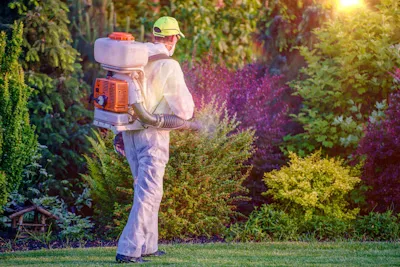
A lawn care and fertilization contractor typically needs pollution liability alongside general liability, because standard liability forms often exclude or limit claims from drift, over-application, and wrong-product mistakes. General liability may still respond to some incidents, but the chemical claims that define an applicator’s exposure are the ones most likely to be excluded.
Adding fertilizer and weed control to a mowing route is one of the most common ways a small lawn care business grows, and it changes the insurance in a way that is easy to miss. The truck now carries product, the crew works close to neighbors’ plants and water, and a mistake can be a claim that a standard policy was written to exclude. This page covers that shift and points to the existing guides for the details, rather than repeating them.
The short answer: the chemical is the exposure
Mowing, edging, and blowing produce a familiar set of claims, and general liability typically responds to many of them. Applying fertilizer, herbicide, or pesticide produces a different set. Drift onto a neighbor’s plants, runoff into water, the wrong product on the wrong lawn, and over-application that damages turf are all claims that arise from the chemical itself.
General liability forms often carry a pollution exclusion, which removes claims arising from the release of certain substances, and the exclusion can reach exactly these events. The page on contractors pollution liability describes the coverage written for them, and the post on what a standard liability policy leaves out maps the other gaps, and the page on lawn care insurance shows how the whole program fits together for a maintenance operation. Nothing here promises how a claim will be decided. The form, its exclusions, and the facts decide it.
Drift: the claim that does not look like pollution
Drift is the claim operators least expect to be excluded. Spray or granular product carried by wind onto a neighbor’s plants, vehicles, or property looks like ordinary property damage, and that resemblance is the trap: the loss can fall under a pollution exclusion even though it feels like a routine accident. The existing guide on whether general liability covers herbicide drift explains the pattern and what to check on the form.
The loss-control side matters as much as the coverage. Wind conditions, nozzle and application choices, buffer areas, and clear instructions to the crew all reduce the chance of a drift event. The best preparation is to know how your policy treats the event before it happens, and to tell your producer what you apply and how.
Wrong product, wrong property, and over-application
Applicator mistakes follow a few patterns. A crew applies a product meant for one turf type to another, treats the neighbor’s lawn instead of the customer’s, or applies more than the label allows. Each is a human error, and each can be an expensive one. The existing guide on the wrong chemical or wrong property walks through how those claims are typically handled and why the answer turns on the form.
Over-application is a particular case, because the harm falls on the work itself. Damage to the turf you were hired to treat is often a different question from damage to someone else’s property, and general liability typically does not pay for your own faulty work. The guide on damage to a customer’s property explains the exclusion that draws that line.
Runoff and the water question
Fertilizer applied near a drain, a pond, or a slope can leave the property. Whether a runoff event is a claim, and under which policy, depends on the facts and the form, and the existing guide on fertilizer or chemical runoff covers it. The practical point for an applicator is to ask whether the policy responds to off-site contamination and what conditions apply, since that is where the largest claims in this trade tend to arise.
For federal background on pesticide use, labeling, and worker safety, the U.S. Environmental Protection Agency maintains the primary material, and its page on pesticide worker safety is relevant to crews who handle product. This page does not summarize them, because the label and the agency’s material are the authority.
Granular, liquid, and why the method matters
Insurers may treat a granular spreader and a liquid spray rig differently, because the two behave differently in the field. Liquid applications can drift on the wind and are more sensitive to nozzle choice and weather. Granular products can bounce onto hard surfaces, wash into drains, or scatter beyond a bed edge. Neither is inherently safer, and what matters is the product, the setting, and the care taken.
When you describe the work, describe both the product and the method. A policy that was written for granular fertilizer on residential turf may not contemplate liquid herbicide on a commercial site, and the reverse. If the mix changes through the season, tell your producer, because the policy is only as accurate as the description it was built on.
Records and training that help when a claim arrives
An applicator’s best protection is a paper trail. Application records that show what was applied, where, when, and under what conditions can help establish what happened if a customer or neighbor makes a claim. Written procedures for the crew, training on product handling, and a habit of checking the address before the spreader opens all reduce both the chance of a mistake and the difficulty of resolving one.
An insurer may ask about these practices when placing the coverage, and a business that can answer clearly is easier to place. None of this guarantees how a claim is decided, but the absence of records can make a manageable claim harder, and the presence of them can show that the business was careful. The EPA’s pesticide worker safety material is a reasonable starting point for what training and handling guidance exists.
The licensed applicator question
Insurers may ask whether the people applying products hold whatever license or certification the state expects for the products being used. The answer can change whether a policy is offered, how it is rated, and whether the application is treated as part of the program. It is also a question the state answers, not the insurer, and it varies from place to place.
This page does not state any state’s applicator rules. For state-by-state background on how we work with lawn care operators, start with the pillar page on lawn care insurance, which links to a page for each state, such as Arizona. Check with the agency that regulates applicators where you work, and tell your producer what applies, so the application and the policy say the same thing.
Real-World Scenario: A lawn care operator who has only mowed for several seasons adds a spring fertilizer and weed control program with a small spray rig and a granular spreader. The existing general liability policy was written for mowing and does not mention chemicals. The producer asks what products will be used, who will apply them, what the license or certification situation is, and how close the work is to neighbors’ plants and water, and then explains that the form probably carries a pollution exclusion and that a pollution coverage may be needed. The operator places the coverage before the first application. The detail that mattered was telling the producer about the spray rig before the season began, not after.
What to describe on the application
A policy for an applicator is built from the description of the work. Say which products you apply, whether the application is granular or liquid, how it is delivered, and how large the area typically is. Say who applies it and what license or certification they hold, if one is expected. Say whether you apply near water or on commercial sites and whether you subcontract any of it.
The more accurate the description, the less room there is for an argument at claim time. A policy written for a mowing business is not a policy for an applicator, even if the mowing is the larger part of the revenue.
What to ask a producer
Ask whether the general liability form carries a pollution exclusion and how it reads. Ask whether pollution liability is available, whether it is part of the program or a separate purchase, and what it responds to. Ask how drift, runoff, wrong-product, and over-application claims would be treated. Ask what the insurer wants to know about licensing and training, and whether any products are excluded. Ask how the rest of the program, including equipment and auto, is affected by carrying product on the truck.
For general guidance on business insurance, the U.S. Small Business Administration is a reasonable reference. When you are ready, you can start a quote and describe the products and the work. For who answers your questions and how we place this class, see about us.