

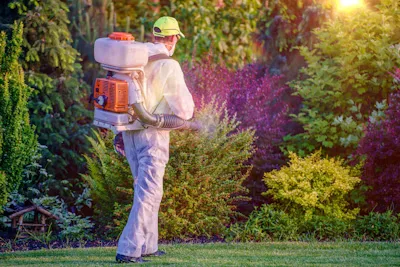
Usually not. When an herbicide drifts onto a neighbor’s property, the standard general liability policy a landscaping or lawn care operator carries will not respond to the drift, the contamination, or the cleanup — its absolute pollution exclusion treats the herbicide as a pollutant and drops that loss. This guide walks exactly why, what general liability still does cover at a drift incident, and what actually responds.
That answer surprises operators, because the loss looks like the textbook thing general liability is for: you damaged someone else’s property. But the chemical cause is what changes the result, and understanding that distinction is the difference between assuming you are covered and knowing you are. Below is the narrow question — drift onto a neighbor — answered in full, with the broader coverage mechanics left to the pages they belong on.
The short answer: usually no, and here is why
The standard commercial general liability form carries an absolute pollution exclusion, and an herbicide fits squarely inside the way that exclusion defines a pollutant. So when your application drifts off-target and lands next door, the part of the loss that is the drift itself — the scorched ornamentals, the contaminated pond or soil, the cleanup — has no general liability response. This is not a coverage that gets argued down at the margins; it is excluded by design. The full mechanics of that exclusion live on our pollution liability page, and the way it sits as one of two seams in the general liability form is covered there — this post stays on the single question operators actually search: what happens when the drift reaches a neighbor.
The trap: drift damage looks like ordinary property damage
Here is where operators get caught. A neighbor’s ornamental beds wilt, a koi pond turns over, a vegetable plot is ruined — and that is property damage to someone else, which is exactly what general liability is supposed to cover. So the assumption is automatic: file it on the general liability policy. The problem is the cause. The damage arises out of the dispersal of an herbicide, and the absolute pollution exclusion removes bodily injury and property damage that arise from a pollutant. The chemical origin is what pulls the claim out of the policy, even though the visible loss — dead plantings, a fouled pond — is the kind of property damage the form normally answers. That is the single most misunderstood point about drift, and it is why a claim that feels obviously covered comes back denied.
Real-World Scenario: A crew sprays a selective herbicide across a turf account on a breezy afternoon and a fine mist carries past the property line onto the neighbor’s ornamental beds and a small backyard pond. The plantings are destroyed and the pond is contaminated. The operator reports it to the general liability carrier expecting a routine property-damage claim — and the carrier points to the pollution exclusion, because the damage arose from an herbicide. The loss is real, the neighbor is owed, and the policy the operator assumed would respond does not. A pollution liability policy is the one that would have.
What general liability might still cover at a drift incident
General liability does not vanish at a drift event — it just answers a different part of it. If something happens at the site with no chemical cause, the policy is back in play. A bystander who trips over your staged hose or equipment and is injured, or a crew member who knocks over and breaks the customer’s property while moving gear, is the routine third-party bodily injury or physical damage general liability is built around. The dividing line is simple: if the loss traces to the chemical, the pollution exclusion controls and general liability is out; if the loss is an ordinary premises or operations injury that happens to occur on the same job, general liability responds. The drift onto the neighbor is the chemical side. The trip-and-fall is the general liability side. One incident can produce both, which is why the two policies are written to sit together.
This matters for defense, not just for the loss itself. A general liability carrier’s duty to defend follows the part of the claim its policy covers, so on a drift event it may step in for an unrelated injury while declining the chemical allegations entirely — leaving you to fund the defense of the drift claim if you have no pollution policy behind it. A claimant rarely sorts the loss neatly into chemical and non-chemical; a neighbor’s demand can bundle the ruined plantings with everything else. Without pollution liability, the most expensive part of that demand — the drift — is the part you are defending and paying on your own.
What actually responds: pollution liability
The line written for the drift is pollution liability. It is the coverage that picks up what the general liability pollution exclusion hands off: the remediation of the affected ground, water, or landscaping, the third-party property-damage and bodily-injury claim to the neighbor, and the defense of the matter. For a lawn care operation the herbicide and fertilizer are not incidental to the work — they are the work — so this is not a precautionary endorsement against a chemical you rarely touch; it is the line your operation runs through on every application, on every route. The full treatment of how it responds, and how it weighs across the landscaping and lawn care models, lives on the coverage page. The point for the drift question is narrow and firm: this policy answers it, and general liability does not.
Check your form for the total pollution exclusion
You can confirm the gap before a claim ever tests it. On your general liability policy, look for the total or absolute pollution exclusion — on a standard ISO form it is the endorsement numbered CG 21 49, though the exact wording and the form number vary by carrier and some policies build the exclusion into the base form instead. If that exclusion is on your policy, your drift and chemical-exposure losses are not covered there, full stop. The fix is a separate pollution liability policy, or in some programs a pollution buy-back endorsement that restores a measure of the coverage onto the general liability form. The two are not interchangeable: a standalone pollution policy is usually written on a claims-made basis with its own limit and defense terms, while a buy-back can carry a sublimit and conditions worth reading closely. Either way, what you are checking for is simple — whether the drift, the cleanup, and the chemical-exposure claim have a policy behind them at all. The move that matters is to have a broker who actually knows the landscaping and lawn care trade read your form and tell you where the chemical exposure sits, rather than assuming the general liability policy reaches it.
Why most operators learn this after a claim
The reason this gap is so common is that nothing about it feels like a gap until it is tested. The operator carries a general liability policy, the policy is real, and the drift loss looks exactly like the property damage the policy describes. So the coverage is assumed, the pollution line is skipped to save a line item, and the assumption holds right up until the afternoon the wind shifts. Then the denial letter explains the pollution exclusion, and the operator is paying the neighbor out of pocket and learning the distinction the hard way. The honest version of this answer is also the useful one: general liability will not cover the drift, and knowing that now is what lets you carry the line that will.
What to do before the wind shifts
Treat the drift exposure as a question of when, not if, because once a product leaves the equipment it is partly out of your hands — wind, vapor, and overspray do not read the property line. Carry pollution liability alongside your general liability, get your current general liability form read for the total pollution exclusion, and make sure the two policies are written to work together rather than assumed into one. The federal framework behind all of this — pesticide and herbicide labeling and use under the EPA pesticide program, drift specifically under the EPA guidance on reducing pesticide drift, applicator certification under the EPA certification framework, and worker safety under OSHA — is the standard your application is measured against, and a clean record there strengthens your position. But the coverage question is settled before any of that: the drift needs pollution liability. When you are ready, start a quote and tell us how your operation runs, read the full pollution liability treatment to see exactly what the line responds to, or step back to what drives landscaping insurance costs to see where the pollution line sits in the program.