

A standard general liability policy for a lawn care business typically leaves out your own employees’ injuries, your vehicles, your own equipment, pollution and chemical claims, damage to the work you are performing, losses caused by uninsured subcontractors, and professional advice. Each of those has its own line that usually fills the gap.
Many lawn care operators buy general liability and assume the business is insured. It is insured for one kind of loss: injury to other people and damage to their property from your operations. The policy was designed to stop there, and the edges are written down as exclusions. This page is the map of those edges. It differs from the page on lawn care insurance, which describes the whole program, and from the post on damage to a customer’s property, which explains one exclusion in depth.
The short answer: general liability protects the public, not the business
General liability is built to respond when your work injures a third party or damages a third party’s property. It is not a policy for your own people, your own machines, or your own mistakes in the work itself. That design is deliberate, and it explains the list of exclusions below.
The words in your policy decide the specifics. Forms differ, and some add exclusions or limitations for particular kinds of work, such as chemical application, snow, or tree work. A producer can walk through the exclusions with you, and the right moment to ask is before you need the policy, not after. Nothing below guarantees how any claim will be decided.
Your own employees
An employee hurt on the job is not a general liability claim. The policy typically excludes injuries to your own employees, because workers compensation is the system built for them. If you have employees, workers compensation is how an on-the-job injury is normally handled, and requirements vary by state.
The trouble for small operators is classification. A helper paid in cash, a seasonal worker, a family member, and a subcontractor without their own coverage can each be treated differently, and the answer can change who is responsible for an injury. The existing guide to injuries from landscaping equipment explains how those claims are typically handled. Ask your producer how the policy treats a helper who is not on the payroll, because that is where the exclusion and the classification question meet, and the answer can differ from what the operator assumed.
Your own vehicles
General liability typically excludes liability from the use of vehicles, which belongs to auto insurance. A truck that carries a crew and a trailer of equipment is a commercial auto matter, and a personal auto policy generally does not respond to business use. Trailers, hired vehicles, and employees’ own cars on business errands each carry their own questions, and the guide to hired and non-owned auto covers the last of those. A loss that begins with a vehicle, such as a trailer detaching or a load shifting, can be an auto claim even when it feels like a lawn care accident, so ask where the line between the two is drawn on your policies.
Your own equipment
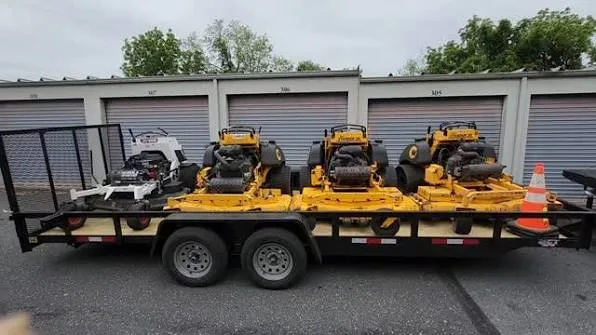
Your mowers, trimmers, blowers, and trailers are your property, and liability does not insure your property. A contractors equipment policy is the usual answer, and the post on whether general liability covers tools and equipment explains why. The page on contractors equipment describes how that line works, including theft, damage, and transit.
Chemicals and pollution
A pollution exclusion is a common part of a general liability form, and it can remove claims that arise from the release of certain substances. For a lawn care operator that applies fertilizer, herbicide, or pesticide, that is the claim that defines the work. A drift event or a wrong-product application can look like ordinary property damage and still be excluded. The existing guide to whether general liability covers herbicide drift explains the pattern, and the page on pollution liability describes the coverage written to fill the gap. For the applicator angle in more detail, see fertilization contractor insurance.
The work you are performing
Many general liability forms exclude damage to your own work and to property in your care, custody, or control. The idea is that a business should bear the cost of redoing its own faulty work, and that the policy is for damage to other things. A crew that over-treats the turf it was hired to treat, or damages the plantings it was hired to maintain, may find that this exclusion is the part of the form that matters.
The line is subtle. A mower that breaks a neighbor’s window is a different claim from a mower that ruins the lawn it was cutting. Ask your producer how the form draws the distinction and whether any endorsement changes it.
Uninsured subcontractors
If you use subcontractors, the policy may treat them differently from employees, and an uninsured sub can pull exposure back to you. A claim caused by a sub’s work may be brought against your policy, and an audit may add the sub’s cost to your premium. Certificates from your subs, and a check of what those certificates actually show, are the standard protection. Ask your producer how your policy treats subs without coverage.
Real-World Scenario: A lawn care company with three employees and one regular subcontractor buys general liability because a commercial client asked for a certificate. During the season a helper is hurt by a mower, the sub’s fertilizer application drifts onto a neighbor’s shrubs, and a trailer of equipment is stolen. The producer’s answers are different for each event: the helper’s injury is a workers compensation question, the drift depends on the pollution exclusion and on whether the sub had coverage, and the stolen equipment depends on whether it was on an equipment policy. The general liability policy was never designed to answer any of the three. The detail that mattered was knowing which line each event belonged to.
Professional advice
If you recommend a treatment plan, design a planting scheme, or advise a customer on what to apply, you are giving advice, and general liability typically does not respond to claims from errors in professional services. For a lawn care operator it is a narrower exposure than for a designer, but it exists whenever the advice itself is what the customer relies on. The post on landscape design insurance explains how a professional liability exposure arises and what typically responds to it. If the advice is a regular part of what you sell, say so on the application, because a policy rated for mowing may not have been priced for recommendations the customer then relies on.
Customizing the policy and checking it against the contract
Most of these gaps are not fixed by buying a bigger general liability limit. They are fixed by adding the right line or the right endorsement, and a producer can usually tell you which of the two applies. Endorsements adjust a form: they can add additional insured status for a client, add primary and non-contributory wording, or change how a particular exclusion reads. Optional coverages add a separate line, such as pollution liability or equipment coverage.
Then check the result against the contract. A commercial client may require certain endorsements, a minimum limit, or proof of workers compensation, and a policy that leaves one out can cost you the account. The post on what insurance commercial clients require lays out how those requirements usually read. Ask your producer to confirm in writing that the policy as written delivers what the contract asks for, and keep that confirmation with the contract. A certificate that promises more than the policy delivers is a problem that only shows itself when a claim tests it.
What to ask a producer
Ask the producer to point to each exclusion in the form and say, in plain language, which line fills it. Ask whether your employees, vehicles, equipment, chemicals, subs, and advice each have a home. Ask which endorsements are available to adjust the form, and what each changes. Ask what happens at audit if a sub has no coverage.
For general business insurance guidance, the U.S. Small Business Administration is a reasonable reference, and your state’s insurance department, listed by the National Association of Insurance Commissioners, can explain how producers and policies are regulated where you work. Compare the answers with how your crew actually works. When you are ready, you can start a quote and describe the work and the crew. For who answers your questions and how we place this class, see about us.