

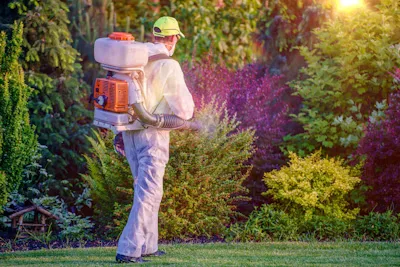
Usually the chemical part is not covered by your general liability policy. When a crew applies the wrong product, mixes the wrong rate, or rolls up to the wrong address and treats a property that was never on the schedule, the burned turf, the killed ornamentals, and the cleanup that follow are a pollution event — and the absolute pollution exclusion on the standard general liability form drops that loss. This guide walks why a simple mistake becomes a chemical claim, what general liability still answers on the same job, and what actually responds.
That answer catches operators off guard, because a misapplication feels like the most ordinary thing in the world: someone made a mistake and damaged property, and damaging property is what general liability is for. But the cause here is a regulated chemical, and the chemical cause is what changes the result. This post stays on the single question an operator searches after a bad application — the wrong product, the wrong rate, the wrong property — and leaves the full coverage mechanics to the pages they belong on.
The short answer: the chemical loss is excluded, and here is why
The standard commercial general liability form carries an absolute pollution exclusion, and a herbicide, pesticide, or fertilizer fits squarely inside the way that exclusion defines a pollutant. So when an applicator puts down the wrong product, doubles a rate, or treats the wrong address, the part of the loss that is the chemical itself — the scorched lawn, the dead beds, the remediation — has no general liability response. It does not matter that the cause was a clerical slip or a misread label rather than wind-driven drift; what matters is that a regulated chemical reached property it should not have, and the exclusion removes property damage that arises from a pollutant. The full mechanics of that exclusion live on the pollution liability page, and the way it sits as one of the two seams in the general liability form is covered there. This post stays on the operator’s own misapplication — the mistake on the job, not a drift onto a neighbor.
The trap: a misapplication looks like ordinary property damage
Here is where operators get caught. An applicator reads a label wrong and burns a customer’s turf, doubles a rate and kills a bed of ornamentals, or transposes two stops on the route and treats the wrong address entirely. The result is damaged property belonging to someone else — which is exactly the loss general liability is supposed to cover. So the assumption is automatic: it is property damage, file it on general liability. The problem is the cause. The damage arises out of the dispersal of a chemical, and the absolute pollution exclusion removes property damage that arises from a pollutant. The human error — the misread label, the wrong address — does not change what the loss is. A regulated chemical reached property it should not have, and that chemical origin is what pulls the claim out of the policy, even though the visible loss looks like the kind of property damage the form normally answers.
This is the difference between this question and a drift claim. A drift onto a neighbor is the chemical leaving your work area on the wind; a misapplication is the operator’s own error on the job — the wrong product, the wrong rate, the wrong property. The mechanism that strips coverage is the same exclusion, but the cause is different, and an operator who understands one does not automatically understand the other. What they share is the outcome: the chemical part of the loss is excluded by design.
Real-World Scenario: A crew is scheduled to treat a customer’s turf with a selective herbicide but grabs the wrong jug off the trailer and puts down a non-selective product at full strength across the front lawn and into the established ornamental beds. The turf browns out within days and the plantings die. The operator reports it to the general liability carrier expecting a routine property-damage claim — and the carrier points to the pollution exclusion, because the damage arose from a chemical. The loss is real, the customer is owed a replaced lawn and beds, and the policy the operator assumed would respond does not. A pollution liability policy is the one that would have.
What general liability might still cover on the same job
General liability does not disappear at a misapplication — it answers a different part of the job. If something happens at the site with no chemical cause, the policy is back in play. A crew member who backs a truck into a customer’s gatepost, knocks over a stone planter while staging gear, or injures a bystander who walks into the work zone is the routine third-party property damage or bodily injury general liability is built around. The dividing line is the same one that runs through every chemical claim: if the loss traces to the chemical, the pollution exclusion controls and general liability is out; if the loss is an ordinary premises or operations mistake that happens on the same visit, general liability responds. The wrong-product application is the chemical side. The backed-into gatepost is the general liability side. One bad day on a job can produce both.
That split matters for the defense, not just the payout. A general liability carrier’s duty to defend follows the part of the claim its policy covers, so on a misapplication it may step in for an unrelated, non-chemical loss while declining the chemical allegations entirely — leaving you to fund the defense of the burned-lawn claim if you have no pollution policy behind it. A customer’s demand rarely separates the chemical damage from everything else neatly; it bundles the dead turf with the dented gatepost and asks you to make it all right. Without pollution liability, the most expensive part of that demand — the chemical damage — is the part you are defending and paying on your own.
What actually responds: pollution liability
The line written for a misapplication is pollution liability. It is the coverage that picks up what the general liability pollution exclusion hands off: the remediation of the affected turf, beds, soil, or water, the third-party property-damage claim to the customer or the owner of the wrongly treated property, and the defense of the matter. For a lawn care operation the chemical is not incidental — applying product is the work, performed across account after account on a recurring route, which is exactly the setting where a wrong jug, a misread rate, or a transposed address turns into a claim. This is not a precautionary endorsement against a chemical you rarely touch; it is the line your operation runs through on every stop. The full treatment of how pollution liability responds, and how it weighs across the landscaping and lawn care models, lives on the coverage page. The point for the misapplication question is narrow and firm: this policy answers it, and general liability does not.
Check your form for the total pollution exclusion
You can confirm the gap before a bad application ever tests it. On your general liability policy, look for the total or absolute pollution exclusion — on a standard form it is the endorsement known as CG 21 49, though the exact wording and the form number vary by carrier and some policies build the exclusion into the base form instead. If that exclusion is on your policy, your misapplication and wrong-property losses are not covered there, full stop. The fix is a separate pollution liability policy, or in some programs a pollution buy-back endorsement that restores a measure of the coverage onto the general liability form. The two are not interchangeable: a standalone pollution policy is usually written on a claims-made basis with its own limit and defense terms, while a buy-back can carry a sublimit and conditions worth reading closely. Either way, what you are checking for is simple — whether the wrong-product, wrong-rate, and wrong-property loss has a policy behind it at all. The move that matters is to have a broker who actually knows the landscaping and lawn care trade read your form, rather than assuming the general liability policy reaches a mistake it is built to exclude.
Why this gap stays hidden until a claim
The reason this exclusion surprises so many operators is that nothing about a misapplication feels like it should fall in a coverage gap. The crew made a human error, the error damaged a customer’s property, and damaging a customer’s property is the textbook general liability event. So the coverage is assumed, the pollution line is skipped to save a line item, and the assumption holds right up until the day a wrong jug comes off the trailer. Then the denial letter explains the pollution exclusion, and the operator is replacing a lawn and a bed of ornamentals out of pocket and learning the distinction the hard way. The honest version of this answer is also the useful one: general liability will not cover the chemical part of a misapplication, and knowing that now is what lets you carry the line that will.
What to do before the wrong jug comes off the trailer
Treat the misapplication exposure the way you treat drift — as a question of when, not if, because a fast route, a full trailer, and a long stop list are exactly the conditions a wrong product, a wrong rate, or a wrong address shows up under. Carry pollution liability alongside your general liability, get your current general liability form read for the total pollution exclusion, and make sure the two policies are written to work together rather than assumed into one. The federal framework behind the application itself — product labeling and use under the EPA pesticide program, applicator certification under the EPA certification framework, and worker safety under OSHA — is the standard your application is measured against, and a clean record there strengthens your position. But the coverage question is settled before any of that: a misapplication needs pollution liability. When you are ready, start a quote and tell us how your route runs, read the full pollution liability treatment to see exactly what the line responds to, see the related case of herbicide drift to a neighbor or fertilizer and chemical runoff, or step back to what drives landscaping insurance costs to see where the pollution line sits in the program.