

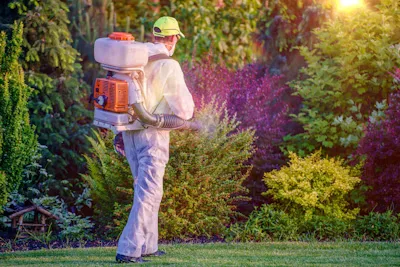
Generally not by your general liability policy. When fertilizer or a lawn chemical runs off a treated property — washed by rain or irrigation into a storm drain, a ditch, a pond, or carried through soil onto a neighbor’s ground and water — the loss that follows is an environmental claim, and the absolute pollution exclusion on the standard general liability form leaves it in a gap. This guide walks why runoff is a pollution loss, the gradual-versus-sudden wrinkle that decides whether your pollution policy even responds, and the line that actually fills the gap.
Runoff surprises operators in a different way than drift or a misapplication does. Those are visible the day they happen — a scorched neighbor’s bed, a burned customer’s lawn. Runoff is quieter: nutrient product or chemical migrating off the turf over a season, surfacing later as a contaminated pond, a fouled storm drain, or a regulator’s letter. But the coverage answer is the same family of problem, and this post stays on the single question an operator searches after the water carries product where it should not be.
The short answer: general liability gaps it, and here is why
The standard commercial general liability form carries an absolute pollution exclusion, and that exclusion removes property damage and bodily injury arising from the discharge, dispersal, seepage, migration, or escape of a pollutant. Fertilizer and lawn chemicals fit the way that exclusion defines a pollutant, and runoff is exactly the seepage and migration the language names. So when nutrient product washes off the turf into a waterway or a neighbor’s soil, the resulting cleanup, the third-party damage, and any regulatory demand have no general liability response — they fall in the gap the exclusion creates. The full mechanics of that exclusion live on the pollution liability page, and the way it sits as a seam in the general liability form is covered there. This post stays on the runoff question itself: the environmental edge of the chemical exposure, and the line that fills the gap.
Why runoff is a pollution loss, not ordinary property damage
Runoff sits at the environmental edge of the chemical exposure, and it changes the shape of the claim. A treatment goes down on the turf as it should, the crew loads up and moves on, and then rain or irrigation carries part of that product off the property — into a storm drain, down a ditch, across a hardscape into a pond, or through the soil toward groundwater. Nutrient runoff in particular is a recognized environmental problem: the federal government treats nitrogen and phosphorus pollution from fertilizer and other sources as a water-quality issue with real downstream effects, the framing the EPA nutrient pollution program is built around. A fertilization route that runs across many properties is, by its nature, putting nutrient product down at scale near drains and waterways, which is why this is the trade’s most environmental loss rather than its most localized.
That environmental character is what takes it out of general liability. A runoff event is rarely a single neighbor’s damaged bed. It can be the contamination of a shared waterway, a storm-drain system, a pond, or a water source, with a cleanup standard set by an agency rather than a property owner. It is an environmental condition arising from a pollutant, and that is squarely what the absolute pollution exclusion is written to remove. The loss looks less like property damage and more like a remediation obligation with a regulator attached — and neither version has a home on the general liability form.
Real-World Scenario: A crew runs a fertilization application across a sloped commercial property the afternoon before a heavy rain. Overnight, nutrient product washes off the turf, across the parking lot, and into a storm drain that feeds a neighborhood pond. Within days the pond shows an algae bloom and a downstream property owner complains; a regulator opens a file and sets a cleanup standard. The operator reports it to the general liability carrier expecting help — and the carrier points to the pollution exclusion, because the loss arose from the migration of a chemical. The remediation, the third-party demand, and the regulatory response are all real, and the policy the operator assumed would respond does not. A pollution liability policy is the one that would have.
The wrinkle that decides whether your pollution policy responds: gradual versus sudden
This is the part of the runoff question operators most need to get right, because carrying a pollution policy is not the end of the analysis — the wording is. Some pollution coverage is written to respond only to a sudden and accidental release: a single, identifiable event at a moment in time. Runoff is frequently the opposite. Nutrient or chemical migrating off the turf over a season of applications and successive rains is a gradual condition, building over time rather than spilling all at once. A policy written only for sudden events can leave that gradual seepage in a second gap behind the first one. The actionable check is simple and specific: confirm your pollution liability form covers gradual pollution conditions, not just a sudden release. This is not a detail to discover in a denial letter; it is read against the way your route actually applies product, and against the slopes, drains, and waterways your accounts sit near, before the policy binds. A broker who knows the lawn care trade asks the gradual-versus-sudden question on purpose, because runoff is exactly the loss that turns on it.
What actually fills the gap: pollution liability
The line written for runoff is pollution liability. It is the coverage that fills what the general liability pollution exclusion leaves open: the remediation the condition requires, the third-party and regulatory exposure that comes with a contaminated waterway or drain, and the defense of an environmental matter, which can be a substantial part of the loss on its own. For a lawn care operation, fertilizer and chemical application is the work, performed on a route at scale across properties and the drains and water near them — so the runoff exposure is not a remote possibility but a feature of the method. This is not a precautionary endorsement; it is the line your operation runs through. The full treatment of how pollution liability responds, and how the environmental side weighs across the landscaping and lawn care models, lives on the coverage page. The point for the runoff question is narrow and firm: this policy fills the gap, general liability does not — and it only fills it if it is written for gradual conditions.
Check your form for the total pollution exclusion
You can confirm the first gap before a runoff event ever tests it. On your general liability policy, look for the total or absolute pollution exclusion — on a standard form it is the endorsement known as CG 21 49, though the exact wording and the form number vary by carrier and some policies build the exclusion into the base form instead. If that exclusion is on your policy, your runoff and chemical-migration losses are not covered there, full stop. The fix is a separate pollution liability policy, or in some programs a pollution buy-back endorsement that restores a measure of the coverage onto the general liability form — and in either case, written to cover gradual conditions, not just a sudden release. The standalone pollution policy is usually written on a claims-made basis with its own limit and defense terms, while a buy-back can carry a sublimit and conditions worth reading closely. What you are checking for is whether the runoff, the cleanup, and the regulatory demand have a policy behind them at all, and whether that policy reaches a gradual loss. The move that matters is to have a broker who knows the landscaping and lawn care trade read your form, rather than assuming the general liability policy reaches an environmental loss it is built to exclude.
Why runoff is the loss operators see coming the least
The reason this gap is so easy to walk into is that runoff is the chemical loss with the longest fuse. Drift and a misapplication announce themselves the same day; runoff can surface a season later, downstream, on property your crew never touched, as a regulator’s letter rather than a customer’s call. So nothing about it feels like a coverage gap until it is tested twice over — once by the general liability pollution exclusion, and again by a pollution policy that only covers sudden events. The operator carries general liability, carries a pollution endorsement, and assumes the runoff is covered right up until the form is read line by line after the loss. The honest version of this answer is the useful one: general liability will not cover runoff, and a pollution policy only covers it if it is written for gradual conditions — and knowing both now is what lets you carry coverage that actually responds.
What to do before the next heavy rain
Treat runoff as a question of when, not if, because slope, soil, a full route, and the weather are all outside your applicator’s control once product is on the ground. Carry pollution liability alongside your general liability, get your current general liability form read for the total pollution exclusion, and — the step specific to runoff — confirm the pollution form covers gradual seepage and not only a sudden release. The federal framing behind all of this — nutrient pollution from fertilizer under the EPA nutrient pollution program, product labeling and use under the EPA pesticide program, and worker safety under OSHA — is the standard your application and your runoff are measured against, and a clean record there strengthens your position. But the coverage question is settled before any of that: runoff needs pollution liability written for gradual conditions. When you are ready, start a quote and tell us how your route runs and what sits downstream of your accounts, read the full pollution liability treatment, see the related cases of herbicide drift to a neighbor and the wrong chemical or wrong property, or learn what contractors pollution liability is.