

It is the separate insurance line written for the chemical exposure your operation runs through — the part your general liability policy is built to leave out. If you have ever heard the term contractors pollution liability, or its cousin applicator pollution coverage, and were not sure what it meant or whether it applied to a landscaping business, the plain-English answer is this: general liability excludes the chemical side of your work by design, and contractors pollution liability is the line that fills that gap. This guide explains what the line is, why general liability leaves the gap, and how to tell whether you need it.
Most operators meet this term for the first time when an account, a contract, or a denial letter forces the question, which is exactly the wrong time to learn it. So this post stays plain and practical: what the line covers, why the gap exists, and the one check that tells you whether the exposure is yours. The full deep-dive — the claim categories, the limits, how it weighs across service models — lives on the pollution liability coverage page; this is the explainer for someone who does not yet know the term.
The short answer: it covers the chemical exposure general liability excludes
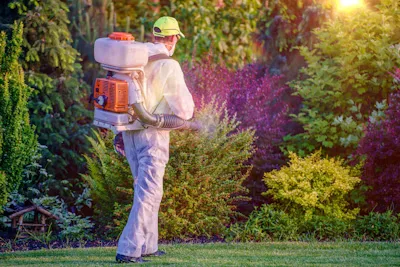
Contractors pollution liability is a line of insurance that responds when your work causes a pollution condition. In plain terms, it answers three things: the cleanup of the contamination, the third-party bodily injury and property damage that condition causes, and the cost of defending the claim. For a landscaping or lawn care operation, a pollution condition is not some industrial spill — it is a herbicide drifting onto a neighbor’s ornamentals, a misapplied product burning a customer’s turf, or fertilizer running off into a storm drain or pond. The line exists for one reason: the standard commercial general liability form carries an absolute pollution exclusion that removes the chemical exposure entirely, and contractors pollution liability is written to fill the gap that exclusion creates. The two lines are not the same thing and not interchangeable — they sit side by side, each covering what the other leaves out. The full mechanics of how the line responds live on the pollution liability page; what follows is the why and the do-I-need-it.
Why general liability leaves the gap on purpose
To understand the line, start with why the gap exists, because it is not an accident. The standard general liability form is built around third-party injury and non-chemical property damage — the rock from a mower, the struck utility, the damaged hardscape. To keep environmental and chemical exposures out of that line, carriers write an absolute pollution exclusion into it. The exclusion defines pollutants broadly, as irritants and contaminants including chemicals, and underwriters read it broadly by design. For a landscaping operator that almost never matters; for a lawn care operator it matters constantly, because the products your crews apply are exactly the chemicals the exclusion names. So the chemical drift, the misapplication, and the runoff that are the most predictable losses of a chemical route are the precise losses general liability is written to remove. The gap is deliberate, which is why filling it requires a separate line rather than an argument with a carrier. Contractors pollution liability is that line.
Do you need it? It depends on whether the chemical is the work
This is the question the title asks, and the honest answer turns on one thing: how much of your work is chemical application. The line is written for the exposure of dispersing a regulated product, so the more of that you do, the more central it becomes.
Real-World Scenario: Two operators sit across the same desk. The first runs a design and build crew — hardscape, plantings, retaining walls — and never puts down a herbicide or fertilizer. Their biggest exposures are a damaged driveway and a stolen skid steer, and contractors pollution liability is a minor consideration at most. The second runs a recurring fertilization and weed-control route across dozens of properties every week. For them the chemical is not incidental to the work — it is the work, applied at scale near drains, neighbors, and water, every stop, every route. The first operator can reasonably treat this line as optional; the second cannot, because the exposure is built into the method itself. Same trade, two very different answers — which is why the work and the products get read before anyone quotes.
If your scope includes any meaningful chemical application — fertilization, weed control, turf-pest treatment, vegetation management — the exposure is yours, and the line is written for it. That chemical intensity runs highest on the lawn care side of a landscaping book, which is where this line is most central. A pure design-build or hardscape shop that never applies product leans far more on equipment and property-damage coverage and carries little of this exposure. The way to know for certain is not a rule of thumb; it is having the work you actually do, and the products you actually apply, read against the policy form. That reading is exactly what the pollution liability page and a broker who knows the trade are for.
The one check that tells you whether the gap is yours
You can confirm the gap before any of this is tested. On your general liability policy, look for the total or absolute pollution exclusion — on a standard form it is the endorsement known as CG 21 49, though the exact wording and the form number vary by carrier and some policies build the exclusion into the base form instead. If that exclusion is on your policy and your crews apply product, the chemical exposure your route runs through is not covered there. The fix is contractors pollution liability, written as a standalone line, or in some programs a pollution buy-back endorsement that restores a measure of the coverage onto the general liability form. The two are different mechanisms: a standalone policy is usually written on a claims-made basis with its own limit and defense terms, while a buy-back can carry a sublimit and conditions worth reading closely. Which one fits depends on your scope of work and what your accounts require. The move that matters is to have a broker who knows the landscaping and lawn care trade read your form and tell you where the chemical exposure sits, rather than assuming the general liability policy reaches it.
A line named for the exposure, not the industry
Part of why this line is unfamiliar is its name. Contractors pollution liability sounds industrial — like it belongs to a demolition outfit or a fuel hauler, not a crew that fertilizes lawns. Applicator pollution coverage is the version of the term written closer to what a lawn care operation actually does. But the substance is the same regardless of the label: it is the coverage for a pollution condition your work causes, and for a chemical route, that condition is a drift, a misapplication, or a runoff. The name describes the mechanism, not the business, which is why operators who do exactly the work the line is built for can go years without recognizing it by name. Knowing the term is half the protection, because you cannot ask for, or check for, a coverage you have never heard of.
What to do with this
If your crews apply chemicals, treat contractors pollution liability as core to the program rather than an extra, and treat the general liability policy as the form that deliberately leaves the chemical gap. Get your current general liability form read for the total pollution exclusion, have your scope of work and your products read against a pollution form, and make sure the two lines are written to work together rather than assumed into one. The federal framework behind the application — product labeling and use under the EPA pesticide program, nutrient runoff under the EPA nutrient pollution program, applicator certification under the EPA certification framework, and worker safety under OSHA — is the standard your work is measured against, and a clean record there strengthens your file. But the coverage question is settled first: a chemical route needs this line. When you are ready, start a quote and tell us how much of your work is chemical application, read the full pollution liability treatment to see exactly what it responds to, see the specific cases of herbicide drift to a neighbor, the wrong chemical or wrong property, and fertilizer and chemical runoff, or step back to what drives landscaping insurance costs to see where the pollution line sits in the program.