

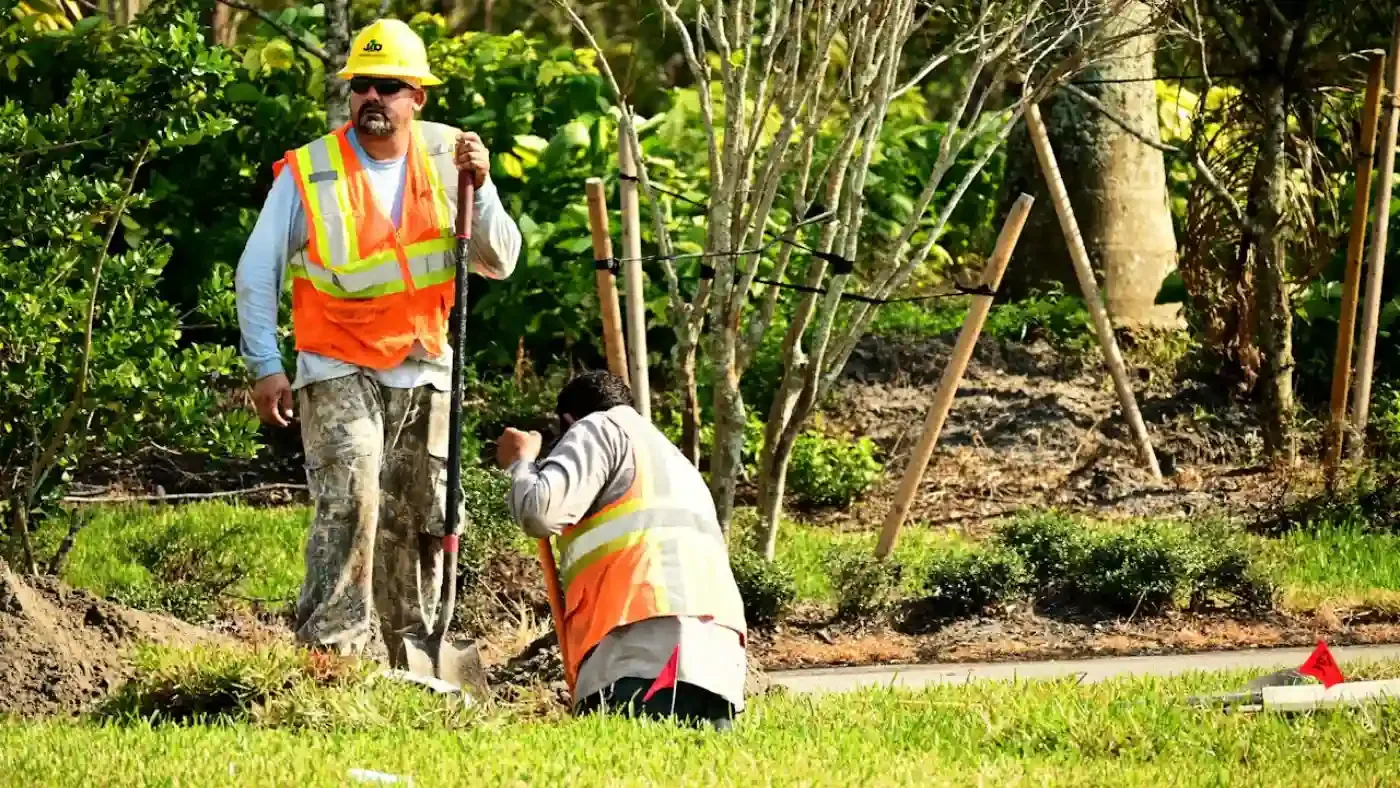
Yes — in almost every case. The moment garden maintenance is done for pay on property belonging to someone else, it stops being a private activity and becomes a business exposure. A personal lines policy will not answer for it. What follows is what actually creates that exposure at small scale, and which lines respond.
The question usually arrives in one form: a maintenance operator with a van, a hedge trimmer, a blower, and a book of standing weekly accounts, wondering whether the word business really applies to work that looks like gardening. It does, and the reason has nothing to do with the size of the machines. Below is what the exposure consists of, which lines answer each part of it, and where maintenance ends and contracting starts.
The short answer: the exposure comes from the property, not the machinery
The trigger is access, not equipment. Every hour of paid garden maintenance is spent on ground that belongs to somebody else, surrounded by things that break — glass, parked vehicles, irrigation heads, lighting fixtures, pets, and the client walking out to talk to you mid-cut. An operator carrying nothing more powerful than a hedge trimmer and a blower can still put a stone through a patio door, or take a mature specimen shrub back to bare wood on a misread instruction.
General liability is the line written for exactly that: bodily injury and physical damage to property belonging to others, arising out of your operations. It is the first policy a garden-maintenance business buys, and at this scale it is often the only liability line needed for a long while. Everything else either protects what the operator owns or answers a contract requirement.
What actually creates the exposure at maintenance scale
Four things, and not one of them requires a machine bigger than a wheelbarrow.
The first is powered hand tools working close to hard, expensive surfaces. A string trimmer running along a gravel edge, a blower clearing a stone drive, a hedge trimmer worked at arm’s length over a boundary — each of them accelerates small objects in directions the operator cannot fully control. The general safety framework for that class of tool sits with OSHA’s hand and power tools material, and the trade-specific hazards are collected under landscape and horticultural services. The claims that follow are mundane and frequent: a marked car panel, a cracked pane, a chipped stone plinth.
The second is height. Hedge work is where a maintenance operator most often ends up on a step ladder, and portable ladder requirements are set out at 29 CFR 1910.23. Worth separating: if the fall injures the client or a passer-by, that is liability. If it injures the operator, general liability does not respond, because the operator is not a third party to their own policy.
The third is transit. Hand tools, a backpack blower, a hedge trimmer, and often a small mower move between sites in the same vehicle every working day, which puts them at risk on the road and, far more often, parked overnight. That is a first-party loss, belonging to a different line entirely.
The fourth is what leaves the site. Green waste has to go somewhere, and clippings and prunings are a material stream in their own right — the EPA tracks them as yard trimmings. Disposal that ends up where it should not be is a nuisance and, on some facts, a pollution question rather than an ordinary liability one.
Why a personal lines policy will not respond
Because it is built to exclude the exact activity that pays the invoice. Personal lines forms carry a business-pursuits exclusion that removes liability arising out of a trade, profession, or occupation — the coverage stops precisely where the paid work starts. The same logic runs on the vehicle side: a personal auto policy contemplates commuting and errands, not a working van running a route of accounts with tools in the back, which is why the operating vehicle eventually belongs on commercial auto.
Business structure is a separate question that gets tangled up with this one. Choosing between a sole proprietorship and an entity — the options the IRS sets out under business structures — decides who owns a liability. It does not decide who pays for it. A sole proprietor answers personally, which is the sharpest version of the problem; an entity without a liability policy simply means the business absorbs the loss instead. Neither arrangement is a substitute for the policy.
General liability: what it answers, and the two seams inside it
It answers third-party bodily injury and third-party property damage arising out of the operations, plus the completed work after the crew has driven away — the products-completed operations side, which matters more than operators expect on planting and bed work that fails weeks later.
Two seams are worth knowing before a claim finds them. The first is care, custody, and control: damage to the particular part of the property you were actually working on is treated differently from damage to the rest of it, a distinction worked through in does insurance cover damage to a customer’s property. The second is direction — the form runs outward only. It never reaches property the operator owns, which is the point covered in does general liability cover my tools and equipment, and the thrown-object claim that sends most maintenance operators looking for the policy in the first place is walked through in a mower threw a rock and broke a window.
Tools and equipment are a separate, first-party line
They sit on a contractors equipment floater, which is inland marine — coverage written to follow property that moves rather than property that stays at one address. For a maintenance operator that is the whole point, because the tools spend their working life in a van rather than in a building.
The floater is usually written with high-value items scheduled individually and the rest of the kit covered blanket, which is how a bag of hand tools, a pole pruner, and spare battery packs get protected without listing each one. Borrowed or hired equipment — an aerator taken out for a weekend, a chipper for a heavy cleanup — is a related but separate question. Contractors equipment is the line, and it is the second thing most garden-maintenance operators buy.
Real-World Scenario: A single-van maintenance operator finishes a standing account on a terraced property, cutting a tall boundary hedge from a step ladder with the client’s car parked below. Cut material and a dislodged stone come down together — one marks the car panel, the other cracks a pane in the conservatory. Both are damage to property belonging to the client, and both are ordinary third-party claims. That same evening the van is left outside the shop and the hedge trimmer and blower are taken from it. That loss is the operator’s own property, and no liability policy responds to it — only the equipment floater does. One day, two losses, opposite sides of the program.
The certificate is what actually unlocks the better accounts
Most operators buy the policy for a contract rather than for a claim. A certificate of insurance is how a client verifies the cover exists before letting anyone onto the property, and managing agents, estate managers, and commercial grounds accounts ask for one routinely. Many also require additional insured status, which passes part of the operator’s liability up to the policy by endorsement.
That single document is the difference between competing on price for one-off work and being eligible for the standing multi-site accounts that make a round profitable. The requirements those contracts carry — limits, additional insured, waiver of subrogation — are set out in what insurance commercial clients require of landscapers.
Where garden maintenance ends and contractor work begins
At the point the work builds, removes, or reshapes rather than maintains. That line matters because it changes two things at once: the physical exposure, and how the operation is classified and rated.
Maintenance keeps a planting scheme in the condition it is already in. Contracting changes it. Design and build, hardscape, grading, irrigation installation, and tree removal all put the operator into excavation, subsurface utilities, structural work, and height — tree work in particular is a distinct discipline with its own hazard profile, not an extension of hedge cutting. Routine maintenance rounds are placed under lawn care, while the build-side work belongs with landscaping, and the licensing consequences of crossing over are set out in do you need a license to run a landscaping business.
The practical failure is drift. An operator who has quietly added a small patio, a run of drip line, or a felled tree to an otherwise routine round is being rated for one scope while performing another, and that mismatch surfaces at the worst possible moment.
Adding a helper, and the van you already drive
Both change the program, and neither waits for the business to feel large. The first hire — seasonal, part-time, a relative on Saturdays — brings workers compensation into the picture, and the rules on who counts as an employee are set by state rather than by the size of the payroll. The vehicle follows the same pattern: once it is carrying tools to paid accounts every day, it is a business auto in substance regardless of what the title says.
Neither is a reason to over-buy early. Both are reasons to report the change, because a program built around a solo operator is not the program a two-person crew needs.
Placing a small maintenance operation without over-buying
Start with the two lines that answer the actual exposure and add the rest as the work demands it. General liability answers the harm the work does to other people and their property. A contractors equipment floater answers the tools. That pair covers the great majority of what goes wrong on a maintenance round, and it produces the certificate the better accounts will ask for.
From there the additions are triggered by facts rather than revenue: a hire brings in workers compensation, a working vehicle brings in commercial auto, a contract limit can call for an umbrella, and a real move into build work forces a re-look at the placement. Requirements differ across the places we write. When it is time, start a quote and describe the round as it actually runs — the accounts, the tools in the van, and anything sitting on the contractor side of the line.