

A seasonal landscaping calendar has a shape every owner knows by heart: a hard climb in spring, a busy plateau through summer, a tapering fall, and then a valley where the mowers sit and the revenue does too. The question of whether to fill that valley with year-round work — snow and ice management, holiday and landscape lighting, off-season cleanups — is really three questions wearing one coat: does it smooth the cash flow, does it keep the crews you need, and does the steadier revenue actually pay for the trade-offs it brings. This guide works through all three honestly, because year-round work is good business for some operations and a distraction for others.
The pull toward year-round revenue is easy to feel and harder to think through. A business that earns most of its money in eight or nine months has to carry twelve months of fixed costs — insurance, the loan on the equipment, the overhead — on that compressed income. Filling the off-season is one way to relieve that pressure. But every line you add brings its own equipment, its own liability, and its own staffing demands, so the decision is not about whether steadier revenue sounds appealing. It is about whether a specific off-season line fits the operation you already run.
The cash-flow case: smoothing the valley
The clearest argument for year-round work is cash flow. Fixed costs do not take the winter off — the equipment loan, the insurance, the shop rent, and the overhead all keep running while the mowing revenue stops. An operation that earns its money in a compressed season has to stretch that income across the lean months, which is why so many owners feel the squeeze in January and February even after a strong summer. Off-season revenue relieves that pressure directly: money coming in during the valley is money you do not have to carry forward from the busy season or borrow against.
The point is not just more revenue but steadier revenue. A smoother income line across the year makes the business easier to run — payroll is more predictable, the equipment loan is easier to service, and the spring start does not begin from a cash deficit. That steadiness has a quieter benefit too: a business that does not run out of money every winter has more room to invest, to wait for the right account, and to negotiate from strength rather than from need. Filling the valley is partly about the revenue and partly about the breathing room it buys.
Crew retention: keeping the people you need
The second argument is harder to put on a spreadsheet but just as real. Good crew leaders, equipment operators, and the people who know your accounts are difficult to find and expensive to replace. A seasonal layoff sends them looking for other work, and there is no guarantee the best of them come back in spring — some find a job they like better, some find one that runs year-round, and you start the busy season short-handed and retraining.
Off-season lines give your crews paid work through the winter, which keeps the people who already understand your operation on the payroll. That continuity is worth more than it looks. A crew that stays together knows the routes, the equipment, and the standards, and it does not cost a spring of recruiting and training to rebuild. When you weigh year-round work, the labor side of the ledger belongs in the calculation: the cost of carrying a crew through a slower season is set against the cost of losing it and rebuilding it, and for an operation that depends on skilled people, retention can be the deciding factor on its own.
The off-season lines that fit a landscaping operation
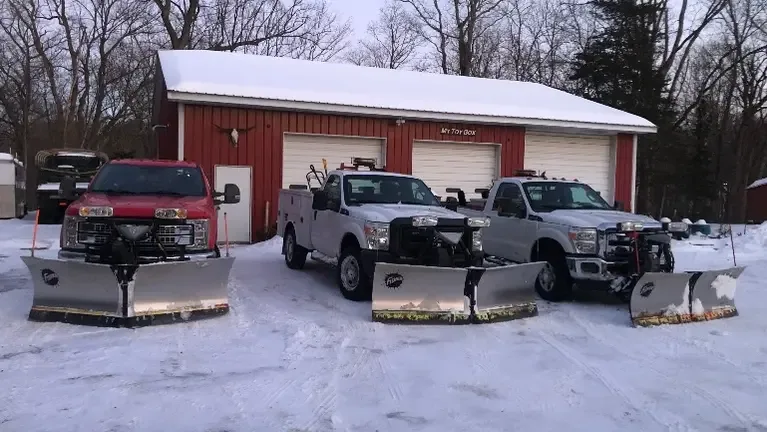
Not every off-season line fits every operation, and the best ones use the equipment and people you already have rather than forcing a large new investment before the demand is proven. Snow and ice management is the most common pairing because it leans on trucks and crews already on hand, turning the same people and vehicles toward winter work. Holiday and landscape lighting installation extends the season into late fall and early winter and tends to be higher-margin project work that showcases a crew’s design skill. Beyond those, some operators add winter cleanups, firewood, or year-round commercial property care.
The discipline is to match the line to the operation. A line that uses idle equipment and retains a crew you would otherwise lay off pays for itself twice — in revenue and in retention. A line that demands a fleet of new specialized equipment, a different skill set, and a separate insurance profile may earn its keep, but only after a real investment, and it should be entered with eyes open rather than as a casual add-on. The question to ask of any off-season line is whether it draws on what you already have or asks you to build something new before you know the work is there.
The honest trade-offs
Year-round work is not free, and the costs land before the steadier revenue does. The trade-offs come in three forms. Equipment is the first: snow and ice work needs plows and spreaders, lighting needs inventory, and each ties up cash and shop space for a line that runs only part of the year. Liability is the second and the one operators underestimate most. Snow and ice management carries slip-and-fall exposure on the lots a crew clears, plowing damage to curbs and pavement, and contract language that can shift responsibility onto the contractor — a risk profile that does not look like summer mowing and should be insured and contracted deliberately rather than treated as an extension of the maintenance season. Staffing is the third: carrying and scheduling a crew through months when the core work has slowed takes management attention and a labor budget that the off-season revenue has to cover.
None of these is a reason to avoid year-round work. They are the reasons to enter it deliberately. An off-season line that is properly equipped, properly insured, and properly staffed can be a strong addition; one bolted on without accounting for the equipment, the liability, and the labor can cost more than the valley it was meant to fill. The trade-offs are manageable — but only if they are counted before the first plow goes on the truck.
Real-World Scenario: A maintenance operation with a strong commercial book reaches the end of a busy fall and faces the usual choice: lay off two crews for the winter or find them work. The owner adds snow and ice management for the same commercial accounts the crews already service, using the existing trucks with plows added. The off-season revenue keeps both crews employed through winter, so the same people return to the spring routes already knowing the accounts — and the contracted snow work, billed on a schedule, adds recurring off-season revenue to the book. The trade-offs are real: the plows cost money, the slip-and-fall exposure means the work has to be insured and contracted carefully, and managing winter scheduling takes attention. But the valley is filled, the crews are kept, and the business carries steadier revenue across the year than it did before.
Where year-round revenue meets the long view
The case for year-round work is mostly about the present — smoother cash flow and a crew that stays — but it reaches the long view too. Contracted, recurring off-season revenue is the kind a buyer reads as durable, so an operation with contracted snow and ice or recurring lighting accounts tends to look steadier than one that goes quiet for months. The lift is not automatic and it is not a number you can claim — it depends on whether the off-season revenue is contracted, recurring, and transferable rather than one-time — but year-round contracted revenue is precisely the profile that strengthens a maintenance book over time, which is part of what a landscaping business is worth when an owner eventually values or sells it.
So the question of whether to go year-round resolves into a clear-eyed comparison: the steadier revenue and the crew you keep, set against the equipment, the liability, and the staffing each line demands. For some operations the math is obvious and the valley is worth filling; for others the off-season is better spent on maintenance, training, and rest. The right answer is the one that fits the operation you actually run, the crews you need to keep, and the contracts you can realistically win. When an off-season line is part of how the operation runs, the next step is making sure it is insured to match — the snow plow, the lighting inventory, and the shifting liability all belong on a coverage stack that reflects the full calendar, not just the summer. To see how the whole operation fits together, browse more owner resources, and when you are ready to insure the business to the way it actually runs across all twelve months, start a quote.