

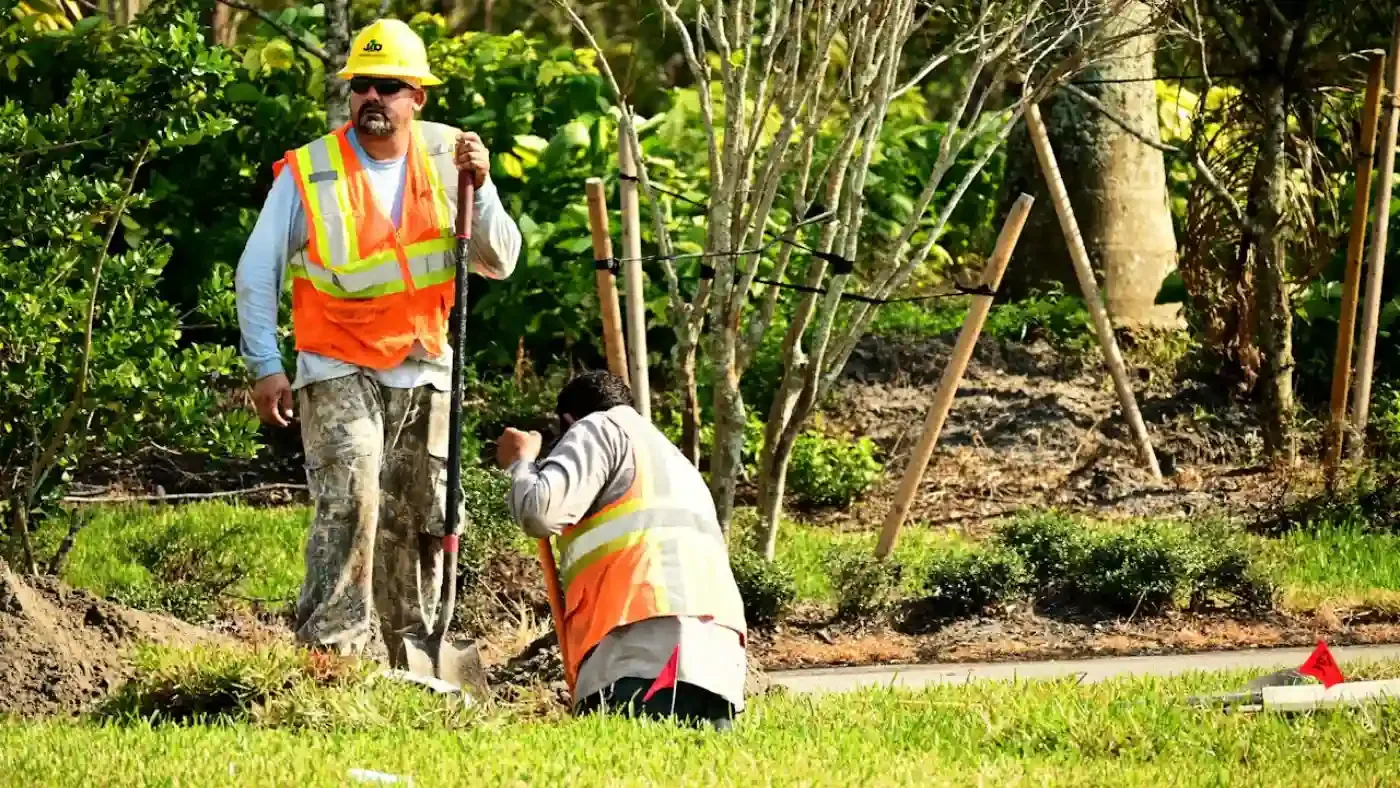
Yes. Heat illness from a full shift in the sun, chemical exposure during mixing or application, a hand caught in a mower or trimmer, a back strained hauling stone, and an injury in a route accident are all work-related injuries, and workers compensation is the single line written to respond to your own crew across every one of them. This guide walks what comp answers for, where the same chemical can touch a second line depending on who is harmed, and the one structural exception — four monopolistic states where the coverage runs through a government fund instead of a private policy.
The reason operators ask is that a landscaping crew gets hurt in ways an office never does, and it is fair to wonder whether one policy really reaches all of it. It does — comp is built around exactly the physical, outdoor, equipment-heavy work your crew does. The deeper coverage mechanics live on the coverage page; this post answers the narrow question an operator actually searches: is the crew covered when they go down from the heat, the chemical, or the equipment, and what changes in the four states that do it differently.
The short answer: comp is the line for your own crew
Workers compensation responds to your own employees’ work-related injuries and illnesses — medical treatment, a share of lost wages while they recover, and disability benefits where the harm lasts. The trades-specific point is that the landscaping injury profile is wide and physical, and comp is the one line that answers across all of it: the heat, the chemical, the blades, the lifting, and the route. The full naming of that injury profile and the state-by-state structure behind it lives on the workers compensation page — this post stays on the single question operators search: is the crew covered for the specific ways landscaping work puts them at risk, and the answer is that this is precisely the line written for it.
Each injury, and where it lands
It is worth walking the injuries one at a time, because the question operators ask is really five questions wearing one coat.
Heat illness is the one operators second-guess most, and it should not be. A crew works full shifts in direct sun through the hottest months of the year; heat exhaustion and heat stroke are a recognized occupational exposure for an outdoor labor force, and comp responds to a worker harmed on the job the same way it does for a cut or a strain. It is not a gray area to argue at the margins — it is a work injury for a landscaping crew.
Chemical exposure has one wrinkle worth getting right, and it turns entirely on who is harmed. When the harm is to your own applicator — a splash, a spill, an inhalation, or skin contact during mixing or application — that is an injury to your worker, and it runs to comp. When the harm is to a third party or the environment, that is the pollution side, a different policy. The same chemical can touch both lines depending on who is hurt, which is why the chemical side is written across pollution liability for the third-party and environmental exposure and comp for the harm to your own crew.
Equipment injury is the trade’s most severe category. Mowers, edgers, trimmers, chippers, and stump grinders run spinning blades and powered cutting heads, and a hand, finger, or foot caught in moving equipment is a catastrophic claim. Comp is the line that answers it for your worker.
Lifting and repetitive strain is the slow version — the backs, shoulders, knees, and wrists that wear down hauling pavers, stone, mulch, and sod, and the strains from a full day of bending and loading. Comp responds to those too.
A route accident is the one that overlaps a second line. When a crew member is hurt in a crash while driving the route or towing a loaded trailer, the harm to the worker runs to comp, while the vehicle and the third-party liability run to commercial auto. One accident, two lines, which is why comp and auto travel together.
Real-World Scenario: On a heat-warning afternoon a crew member finishing a long maintenance route goes down with heat exhaustion and is taken in for treatment; the same week, another worker catches a hand on a trimmer head and needs surgery. Neither injury looks like the other, and an operator new to the trade might wonder whether one policy reaches both. It does — both are work injuries to the operation’s own crew, and workers compensation responds to the medical care and a share of the lost wages for each. The line is built for exactly this range, from the heat that builds over a shift to the blade that does its damage in a second.
The one exception: the four monopolistic states
There is a single structural exception worth being exact about, because it is a verifiable fact rather than a quirk of any one program. In four states — North Dakota, Ohio, Washington, and Wyoming — private insurers are not allowed to write workers compensation at all. These are the monopolistic states, and the only place to obtain the coverage is each state’s own government fund: Workforce Safety and Insurance in North Dakota, the Ohio Bureau of Workers Compensation, the Department of Labor and Industries in Washington, and the state-administered fund in Wyoming. These are government programs, not private carriers.
For a landscaping operation with crews working in one of these four, the consequence is concrete: your private comp policy does not stretch to cover the exposure there. The crew is still covered for the heat, the chemical, the blade, and the strain — but the coverage comes through the state fund, and the obligation attaches when the work happens rather than when you get to the paperwork. The deeper treatment of how the monopolistic states and multi-state payroll work lives on the workers compensation page; the point for this question is that the answer to “is my crew covered” is yes in all fifty states, but in four of them the coverage is bought from the state rather than the private market.
The actionable check: classify the work, place the state funds
The move that makes comp respond correctly is getting two things right. First, classify your payroll to the work your crew actually performs — design and build, maintenance, irrigation, or lighting each carry a different exposure, and the coverage is rated and responds against the real work rather than a generic landscaping class. Classification is the foundation the rest of the structure sits on, and getting it wrong builds the policy on the wrong picture of your operation. Second, map your footprint against the four monopolistic states: where a crew works in North Dakota, Ohio, Washington, or Wyoming, the state fund handles workers compensation, while your private package continues to handle the general liability, the contractors equipment, and the pollution liability side of the operation. The split is clean once it is drawn: comp from the state fund in those four, comp from the private policy everywhere else, and the rest of the program the same across every state.
Why this matters before a claim
The reason to settle this in advance is that the crew is the part of the operation most certain to be tested. A truck might never wreck and a trailer might never be stolen, but on a long enough timeline a crew working outdoors around powered blades and chemicals will get hurt — that is the nature of the work, not a failure of it. Operators who classify the payroll honestly and place the state-fund coverage before a crew crosses into a monopolistic state are the ones whose comp simply responds when the injury comes. The rest discover the classification problem or the missing state-fund placement in the middle of a claim, when the worker is already hurt and the coverage is the question. The honest answer is the reassuring one: your crew is covered for the heat, the chemical, and the equipment — comp is built for exactly this — as long as the policy is structured to your real work and your real footprint.
What to do for your crew
Build comp to the way the work actually puts your crew at risk. Classify the payroll to the real work, schedule the states your crews operate in, and place the state-fund coverage anywhere your footprint touches North Dakota, Ohio, Washington, or Wyoming — then keep the rest of the package, the general liability, commercial auto, contractors equipment, and pollution liability, built around it. The federal worker-safety framework behind the outdoor and chemical exposures — heat and general workplace safety under OSHA and pesticide handling under the EPA pesticide program — is the standard your crew’s safety is measured against, and a clean record there strengthens the whole file. When you are ready, start a quote and tell us where your crews work and what they do, read the full workers compensation treatment to see how the classification and state structure are built, or step back to what drives landscaping insurance costs to see where comp sits in the program.